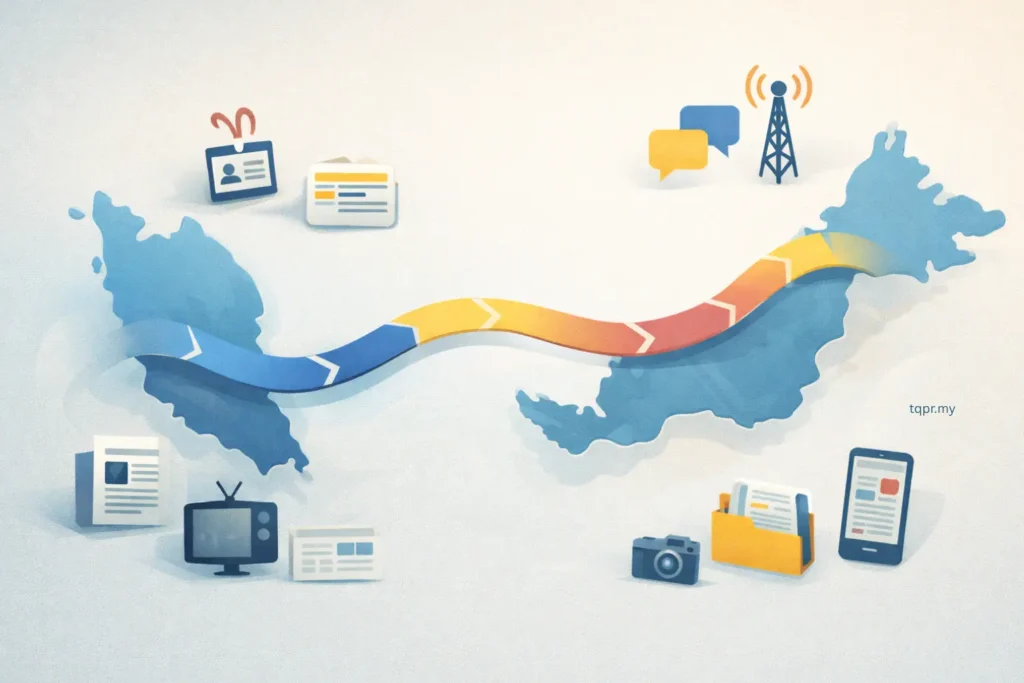
A Public Relations Launch Plan in Malaysia works best when you treat it as a 90-day sequence, not a one-off press blast.
This public relations launch plan in Malaysia is designed for new entrants who need media relations and strategy, not random outreach. If you’re still learning the landscape, start with our PR in Malaysia field guide. You spend Day 0 to Day 14 locking positioning, spokespeople, and measurable goals. From Day 15 to Day 45, you build a Malaysia media list and a bilingual press kit that makes coverage easy. From Day 46 to Day 75, you run briefings and targeted one-on-ones, plus controlled influencer pilots where relevant. From Day 76 to Day 90, you amplify confirmed placements, monitor bilingual accuracy, and shift KPIs toward quality and outcomes.
Key Takeaways for a Public Relations Launch Plan in Malaysia
- Build foundations first, then outreach, then momentum, then amplification. This is how a Malaysia PR launch plan stays coherent.
- Prepare bilingual assets early so English and Bahasa Malaysia coverage stays aligned and fast to publish.
- Measure beyond pickup volume. Track message accuracy, outlet relevance, and actions driven by coverage.

How to Use This 90-Day Earned Media Timeline in Malaysia
Use the timeline as four phases with clear gates. Think of it as your workflow for a public relations launch plan in Malaysia, from assets to outreach to measurement. Phase 1 is about baseline and story clarity. Phase 2 is about assets and target lists. Phase 3 is about journalist interaction and momentum. Phase 4 is about amplification, monitoring, and learnings. If you do not have the assets ready before outreach, you will waste time replying to questions that should have been answered by your one-page summary and press kit.
Day 0 to Day 14: Malaysia PR Foundations
Start with a Malaysia-focused audit. You are looking for what is already being said about you, what competitors are owning, and what proof you can share without getting into messy verification cycles. Then build personas in two directions: journalist personas by beat, and stakeholder or customer personas by language preference, concerns, and desired outcomes.
After that, lock positioning. Keep it simple: one core positioning sentence, three proof points that are verifiable, and two quote options your spokesperson can repeat without drifting. Finally, set SMART goals for 90 days that you can actually measure. This keeps your public relations launch plan in Malaysia measurable from Day 1, not just ‘busy’. If you want a clean KPI set, use our PR KPIs in Malaysia guide.
By Day 14, you should have a one-page summary draft, spokesperson shortlist, a basic beat map, and baseline measurement notes.
Day 15 to Day 45: Earn Credibility (Media Lists, Press Kits, Embargo Planning)
This phase turns strategy into a newsroom-ready kit that makes your public relations launch plan in Malaysia easier to execute and easier for journalists to cover. Build a segmented Malaysia media list, not one big list. Split by mainstream national, business, tech, lifestyle, finance, trade, and regional desks if Sabah and Sarawak matter for your launch.
Then finalize your bilingual press kit. If you want the structure journalists scan fastest, use our press release Malaysia checklist as your default template. Keep it newsroom-friendly and easy to scan:
- One-page summary
- Press release (English and Bahasa Malaysia, or Bahasa Malaysia lead with an English link)
- Company backgrounder (short)
- Spokesperson bios and quote pack
- FAQ sheet (tight and factual)
- Asset folder (logos, photos, captions, short b-roll if relevant)
- Clear media contact details and response expectations
Keep the kit tight. If it cannot be scanned in two minutes, it will not be used.
If you plan to use embargoes, decide who gets early access, what is safe to share, and what waits until launch day. Embargo works best when you use it selectively with priority beats, not as a blanket tactic.
By Day 45, you should have a clean media list, a publish-ready press kit, and a simple embargo and briefing plan.
Day 46 to Day 75: Build Momentum (Briefings, One-on-Ones, Controlled Pilots)
Now you shift from preparation to interaction. Run a focused editor briefing, usually virtual is easiest. If you’re choosing between formats, see our PR format in Malaysia guide so your rollout matches the story and the beat. Keep it tight: one clear hook, what is new, one proof point, then Q&A. Capture questions carefully because those questions tell you where your message is unclear, and what journalists are likely to write incorrectly if you do not fix it.
Schedule one-on-ones for priority beats or sensitive topics where spokesperson media and message training helps message control matter more. Your goal is not volume, your goal is depth and accuracy. For influencer pilots, keep it controlled and aligned. Small batch, clear briefing notes, and track feedback like confusion points and objections. That feedback improves your press materials and your spokesperson answers.
By Day 75, you should have briefing notes, updated FAQs based on real questions, and a shortlist of angles that actually trigger replies and coverage.
Day 76 to Day 90: Amplify, Monitor, and Pivot KPIs
In the last stretch, stop chasing random pickups. Amplify the placements that are accurate, relevant, and tied to outcomes. Push these through owned channels and partner shares, and only add paid boosts if they improve distribution of strong coverage.
Monitor bilingual mentions closely to catch translation drift and message errors, and keep public messaging aligned with local content standards where relevant. Fix inaccuracies fast with polite correction notes and updated assets. This is also where you pivot KPIs from volume to quality: message accuracy, outlet tier relevance, share of voice movement, referral traffic, and enquiry signals.
Close the 90 days with a short report that shows what worked, what beats responded, what angles failed, and what you will do next.
After Day 90: Scalable Malaysia PR Roadmap
After the launch sprint, move into cadence. If you want help building the media list, bilingual kit, and rollout system, work with a Malaysia PR team that can run it end-to-end. A solid public relations launch plan in Malaysia should evolve into repeatable monthly and quarterly routines. Do monthly media touchpoints, quarterly asset refreshes, and ongoing bilingual monitoring. Build templates so your next campaign is faster: press release template, one-page summary template, pitch templates by beat, and a consistent quote pack structure.
Malaysia PR Launch Plan FAQ
What is a media plan in PR?
A media plan in PR is the roadmap for who you target, where you pitch, what you send, when you send it, and how you measure results. In Malaysia, it also includes language planning and beat segmentation so you do not treat the market like one audience.
During which phase of a public relations campaign are media forms selected?
You select media forms during the planning phase after goals, positioning, and spokespeople are clear. That is when you decide whether you need press releases, briefings, one-on-ones, or a hybrid sequence, and you prep the assets that make those formats work.
How many outlets should we target in a 90-day public relations launch plan in Malaysia?
Start with a tight list you can actually serve well. For most new entrants, 25 to 60 priority outlets is enough for the first 90 days, segmented by beat and language. If you blast 300 contacts with weak assets, you burn the list fast. If you need a segmentation baseline, use our PR in Malaysia field guide.
Should we use one press release, or multiple releases across 90 days?
Most launches perform better with 1 main announcement plus 1 to 2 supporting releases tied to real milestones (partnership confirmed, rollout expansion, new data point, event). If everything is shoved into one mega release, journalists struggle to extract the headline. Use our press release Malaysia checklist as your structure each time.
When should we use a press event, virtual briefing, or one-on-ones during the 90 days?
A simple rule:
– Use virtual first for reach and speed
– Use one-on-ones for priority beats and sensitive angles
– Use press events only when visuals or demos truly change coverage quality
If you want the decision logic and rollout sequencing, refer to our PR format in Malaysia guide.
What does “bilingual press kit” actually mean in practice?
At minimum, it means your key items are publish-ready in both:
– Bahasa Malaysia (for mainstream Malay outlets)
– English (for corporate and regional desks)
Keep the core facts consistent, and avoid messy mixed-language leads. Your press kit structure should follow your one-page summary, releases, quote pack, FAQs, and asset folder. Use the press release Malaysia checklist as the format baseline.
What should we measure so this public relations launch plan in Malaysia is not just “busy work”?
Track quality signals, not just volume:
– Replies and briefing requests
– Message accuracy
– Outlet relevance
– Referral traffic or enquiry signals (if applicable)
If you want a ready KPI set, use our PR KPIs in Malaysia guide.
Final Word: Launch PR in Malaysia With a 90-Day Plan
A public relations launch plan in Malaysia works when you stage it. Foundations first, then assets, then journalist interaction, then amplification. Build bilingual materials early, so English and Bahasa Malaysia coverage stays aligned. Measure beyond pickup volume, and protect message accuracy. If you run this 90-day earned media timeline properly, you enter Malaysia with credibility and momentum, not noise.