
If you want an agency to move quickly and land earned media that supports the business, the brief matters more than most clients expect. How to Brief a Public Relations Agency in Malaysia is not about writing a long document. It is about sharing the right context, decision rights, sensitivities, and assets early so your PR partner can shape the angle, choose the right PR format, and execute media relations and strategy without chasing clarity for weeks.
Key Takeaways: How to Brief a Public Relations Agency in Malaysia
- Start with business context and the change that triggered PR, then state the outcome you actually want.
- Define your primary audience and where they get information in Malaysia, including language needs when relevant.
- Make approvals predictable: who signs off, how fast, and what is off-limits.
- Share proof points and spokespeople access before outreach begins.
- Choose the right format early, press release, media briefing, virtual briefing, or media one-on-one.
- Align reporting on message accuracy and stakeholder impact, not only “coverage volume.”
Why Briefing a Public Relations Agency in Malaysia Matters
Malaysia media relations runs on clarity, responsiveness, and credibility. When your agency has a clean story, access to a spokesperson, and a stable approval workflow, it can move faster across national outlets, trade media, and relevant creator ecosystems. When those inputs are missing, even a strong idea gets stuck in internal loops, last-minute rewrites, or inconsistent messaging across languages.
A good brief also protects you. It reduces the risk of accidental over-claims, poorly timed releases, or contradictory statements that can be screenshot and recirculated. It also helps your team and agency stay aligned to basic standards around accuracy and fairness, see PRCA Malaysia’s Code of Ethics and Integrity.
The 10 things a Public Relations Agency in Malaysia Needs
Below are the ten inputs agencies typically need in Malaysia. You can share them in a deck, email, or doc. The format matters less than the completeness.
1) Your one-line business snapshot
Who you are, what you do, where you operate in Malaysia, and what makes you different in plain language. Avoid brand slogans. Give the sentence you would want a journalist to understand on first read.
2) What changed and why PR matters now
Is this a launch, expansion, leadership change, policy update, reputation issue, or a shift in category positioning? This “why now” is often the real story hook.
3) The outcome you want, not just “coverage”
State the business outcome in one sentence. For example: build trust after a service issue, introduce a new category, position an executive as a credible sector voice, or improve employer reputation for hiring. This helps the agency choose tactics that fit your goal.
4) The audience you need to move first
Name the primary audience and any secondary audiences. In Malaysia, it often matters whether you are speaking to consumers, corporate decision-makers, government-linked stakeholders, investors, talent, or industry communities. Add where they typically pay attention, such as business press, trade titles, LinkedIn, creator-led platforms, community pages, or internal channels.
5) Language and stakeholder context
If you operate in multiple languages, say so early. If you are coordinating regionally too, use a multi-market PR planning workflow so approvals and meaning stay consistent. You do not need to publish everything in every language, but you do need consistency. Flag any language requirements for press materials, spokesperson availability, or customer support responses so messaging does not drift between versions.
6) Your three core messages and what proves them
Agencies need message house strategy and development and proof points. Share the three points you want repeated, plus the supporting facts you are comfortable standing behind. If you cannot share numbers, give qualitative proof, process proof, third-party validations, or clear examples that are safe to say publicly.
7) What is sensitive, restricted, or off-limits
This is where many briefs fall apart. Include topics you cannot comment on, claims you cannot make, competitor sensitivities, and any compliance review steps that slow approval. If legal must review, specify what triggers legal review instead of routing every line by default.
8) Spokespeople, roles, and availability
List who can speak on record, who is best for background, and who should never be quoted. Add realistic availability windows. A great media one-on-one plan fails if the spokesperson is not reachable for quick prep and follow-up.
9) Past PR learnings and current narrative risk
Share recent wins, misunderstandings, previous press releases, recurring misconceptions, and any topics that reliably attract controversy. Agencies do not need perfect history. They need enough context to avoid repeating the same mistakes.
10) Budget range, timeline reality, and how decisions get made
Give a budget range, even if it is broad, so scope is realistic. If you want a planning baseline, use a 90-day public relations timeline to set expectations on outreach sequencing and approvals. Share the hard deadline, any immovable dates, and the approval workflow: who signs off and what the expected turnaround time is. In Malaysia, speed of approval often determines whether you get a timely story or a late one.
A Simple One-Page Brief for a Public Relations Agency in Malaysia
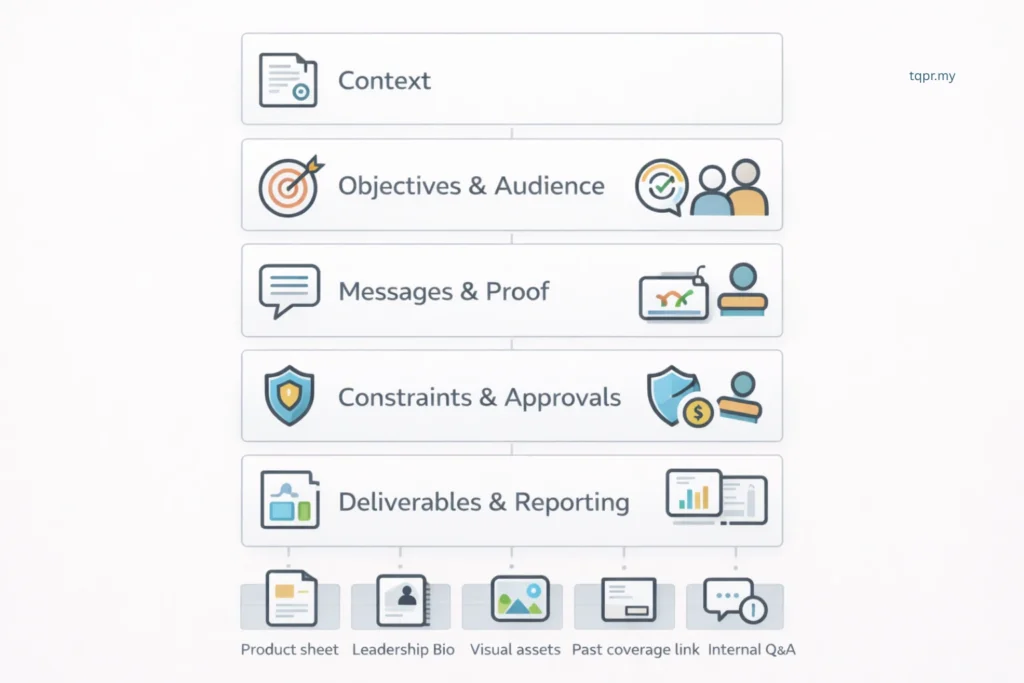
You can keep your PR format tight and still be complete. A one-page brief plus attachments is usually enough.
Start with a short “Context” paragraph, then a “Objectives and audiences” paragraph, then “Messages and proof,” then “Constraints and approvals,” then “Deliverables and reporting.” Put supporting documents behind it: product sheets, leadership bios, visual assets, past coverage links, and a short internal Q&A if the topic is complex.
If you want the agency to respond fast, include one line at the top: the decision-maker for this brief and the expected approval turnaround time.
Choosing the Right PR Format for Malaysia Media Outreach
Different formats serve different goals, and choosing early saves time.
A press release works best when the story is simple, verifiable, and easy to summarise. If you want the structure Malaysian editors can lift fast, use this press release Malaysia checklist. A media briefing works better when the topic needs context, like policy changes, technical products, safety updates, or multi-stakeholder issues. A virtual briefing can be useful when you need speed, wider attendance, or regional coordination. A media one-on-one is effective for leadership positioning or sensitive topics where nuance matters, but only when you can support it with preparation and verified facts. A press event only works when the event itself is newsworthy and you can back it with access, visuals, and a clean story.
If you need bilingual press materials, treat it as part of the plan, not a last-minute translation task. It affects review time, consistency, and spokesperson prep.
Approvals and Timelines When Working With a Public Relations Agency in Malaysia
Most PR delays are not caused by journalists. They come from internal uncertainty: unclear decision rights, slow approvals, missing proof points, and spokesperson gaps.
If your internal review time is long, your agency can still work, but it needs to plan around it. That may mean fewer last-minute pivots, earlier preparation of a messaging bank, and a stronger emphasis on materials that do not require daily sign-off. If you need speed, make speed possible by assigning one approver, defining what legal must review, and giving your agency the assets early.
Measurement and Reporting That Matches PR Reality
PR reporting in Malaysia is most useful when it focuses on message accuracy and stakeholder impact. Track whether priority messages were carried through, whether the framing stayed fair, whether quotations were accurate, and whether the coverage generated the right inbound questions from customers, partners, talent, or regulators.
If you want share-of-voice style tracking, agree upfront on the competitor set, the topics, and the time window. Otherwise you end up reporting noise rather than insight.
Common briefing mistakes that slow everything down
A few patterns cause repeat friction. Clients brief for “coverage” instead of an outcome. Approvals are unclear, or leadership rewrites tone after the agency has already pitched. Spokespeople are nominated but not available. Proof points are held back until after outreach begins. Language versions are treated as “minor edits,” then drift creates contradictions across channels.
If you want speed and consistency, keep the brief simple, but complete.
Public Relations Agency in Malaysia FAQs
Do I need a long document to brief a PR agency well?
No. A one-page brief plus attachments is enough if it includes outcome, audiences, messages, constraints, spokespeople, timeline, and approvals.
Should I share a budget range?
Yes. Without a range, the agency cannot scope deliverables, staffing, or the right mix of media outreach, content development, and measurement.
Do we need bilingual press materials in Malaysia?
Only if your audiences, outlets, or stakeholders require it. If you do need it, plan it early so meaning stays consistent across versions and approvals do not bottleneck.
Can an agency guarantee coverage?
No credible agency should promise specific coverage outcomes. What they can commit to is process quality, targeting, readiness, responsiveness, and disciplined execution. If you want realistic expectations, align deliverables to PR KPIs in Malaysia instead of chasing a coverage number.
What if we have compliance or legal sensitivities?
Share them upfront and define what triggers legal review. The agency can propose safer angles and avoid rework, especially for regulated or high-scrutiny topics.
Who should be the spokesperson?
Choose someone credible, available, and calm under questioning. If your best subject expert is not media-ready, use them for background and put forward a trained spokesperson.
Final Word: Brief a Public Relations Agency in Malaysia With Clarity
How to Brief a Public Relations Agency in Malaysia comes down to clarity and decision discipline. Share the business outcome, the audience, the three messages, proof points, constraints, and who approves what. Choose the right PR format early, press release, media briefing, virtual briefing, or media one-on-one, and align reporting on message accuracy and stakeholder impact. When the brief is clean, agencies spend less time chasing information and more time delivering credible media relations and earned media that supports the business. More practical playbooks are in the Insights hub.