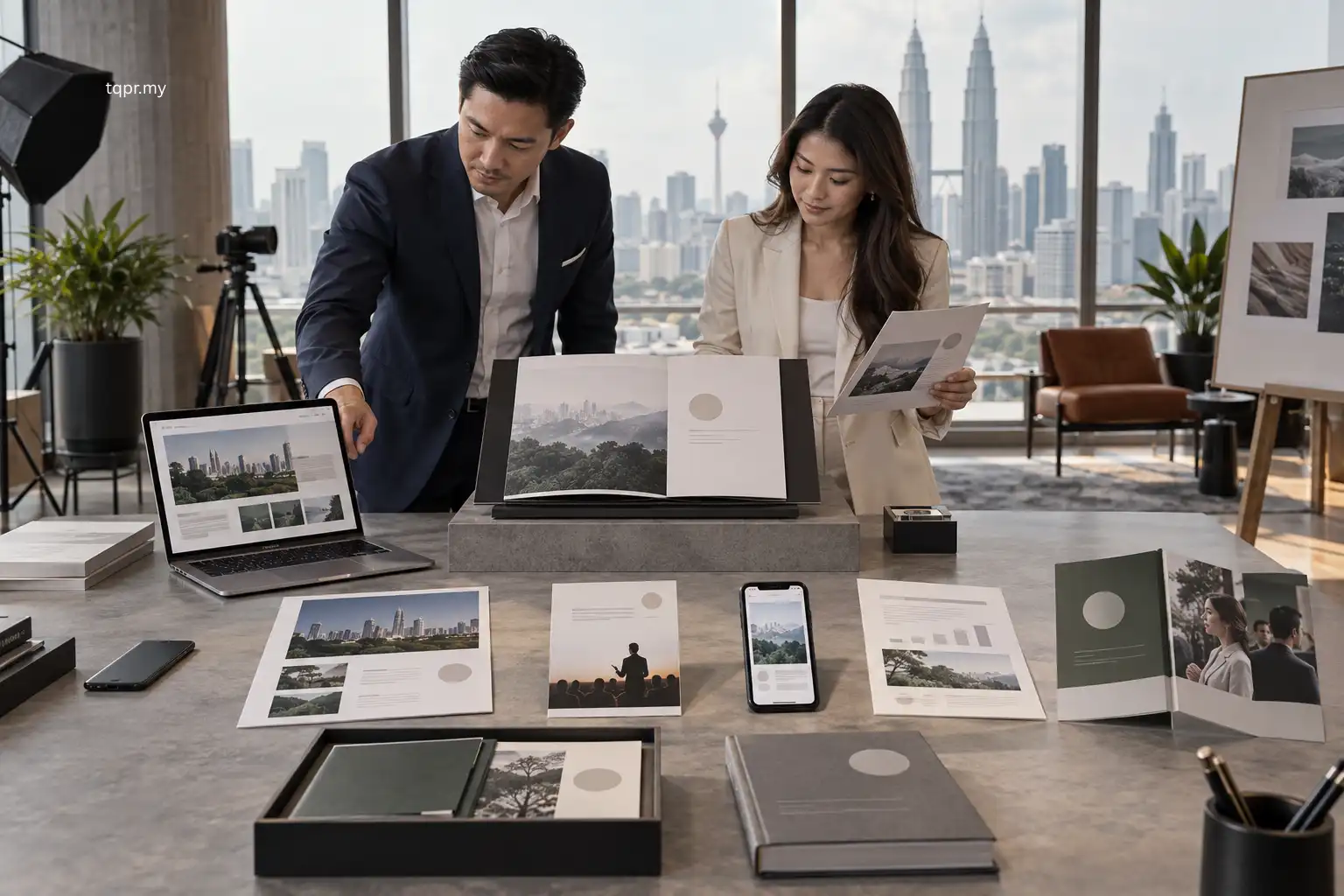
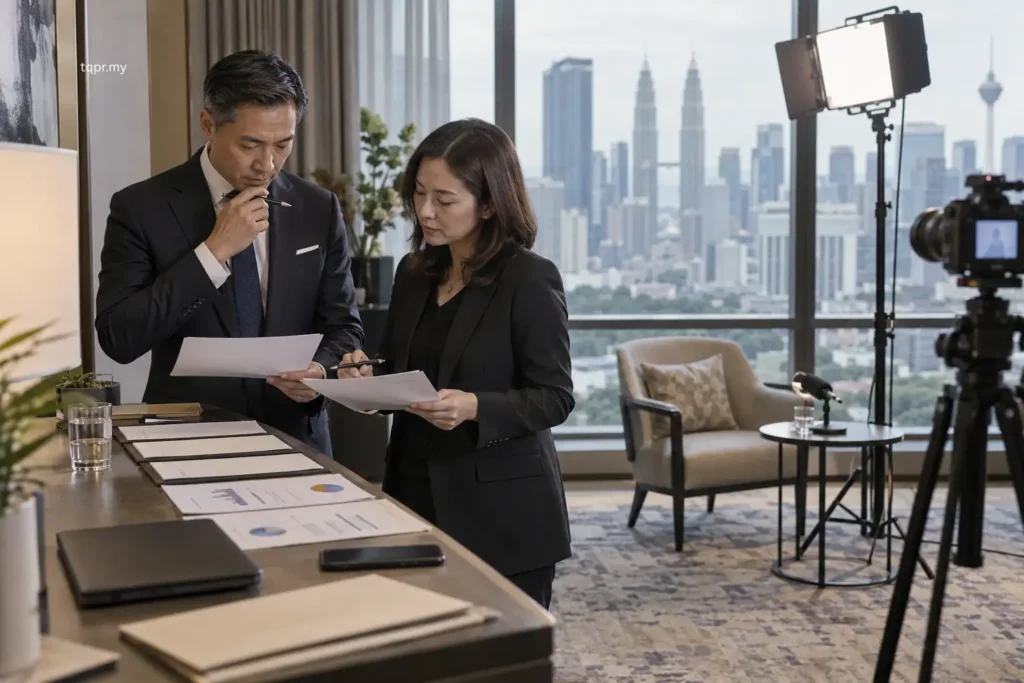
To prepare for a media interview, a spokesperson should first understand the outlet, journalist, audience, format and purpose of the conversation. The next priorities are to agree on a small number of messages, verify the supporting facts, anticipate difficult questions, define communication boundaries and rehearse concise answers aloud.
Good preparation does not mean memorising a script or controlling every question. It means knowing what the organisation can say, what it needs the audience to understand and how to respond credibly when the conversation moves in an unexpected direction.
For Malaysian spokespeople, preparation may also involve choosing the right interview language, adapting regional information for local relevance and ensuring claims fit the Malaysian market. A technically correct global answer can still create confusion if it ignores local operations, regulations or stakeholder concerns.
This guide explains how to prepare for a media interview once an opportunity has been offered or confirmed. It complements formal spokesperson training in Malaysia, but does not replace realistic rehearsal for high-risk, live or unfamiliar interview situations.
Key Takeaways
- Confirm the outlet, journalist, format, audience, deadline and interview conditions before accepting.
- Treat every media interview as a specific editorial opportunity, not a generic speaking engagement.
- Define one interview objective and no more than three priority messages.
- Support every important claim with current, approved and explainable evidence.
- Prepare for the questions the organisation fears, not only the questions it hopes to receive.
- Answer the actual question before bridging to a relevant message.
- Rehearse aloud under realistic time and format constraints.
- Never guess, speculate or assume an informal remark cannot be used.
- Prepare technical, visual and logistical details before interview day.
- Record follow-up commitments and correct genuine factual errors quickly.
Why Media Interview Preparation Matters
A media interview is not the same as a presentation. In a presentation, the speaker controls the sequence, timing and emphasis. In an interview, the journalist decides what to ask, when to follow up and which parts of the answer may be used.
That does not make the interaction hostile. It simply means the spokesperson needs a different form of readiness. The strongest interviewees listen carefully, answer directly and communicate useful information without surrendering factual accuracy or organisational boundaries.
Poor preparation commonly produces one of two problems. Some spokespeople speak at length because they have not decided what matters. Others become so cautious that every answer sounds empty, defensive or scripted.
A useful media interview plan reduces both risks. It gives the spokesperson a clear route through the likely questions without pretending the conversation can be controlled.
When you prepare for a media interview properly, you create a structure between these extremes. The spokesperson has enough clarity to be concise and enough command of the facts to remain responsive.
Reuters states that its journalism is governed by accuracy, independence, integrity and freedom from bias. While each newsroom has its own standards and working style, spokespeople should expect reasonable claims to be questioned and verified. Preparation should therefore improve the quality of the information given, not attempt to manipulate the journalist.
The World Health Organization’s communication principles also emphasise technical accuracy, transparency about what is known and unknown, audience relevance and choosing the right spokesperson. These principles are useful beyond health communication because credibility depends on more than confident delivery.
How to Prepare for a Media Interview in 9 Steps
1. Confirm the Interview Details Before You Say Yes
The first step when you prepare for a media interview is to understand what you are being asked to do. An interview request may sound straightforward while leaving important details unclear.
Confirm:
- The journalist’s name, outlet and contact details
- The intended topic and current news angle
- The likely publication or broadcast date
- Whether the interview is live, recorded or written
- Whether it will take place in person, by phone or online
- The expected duration
- The language of the interview
- Whether other guests or spokespeople are involved
- Whether video, photography or additional content will be captured
- The deadline for any follow-up information
Ask how the interview arose. Is the journalist covering a company announcement, seeking expert comment, comparing several businesses or investigating an issue? The answer changes the level of risk and preparation required.
Do not demand a complete list of questions as a condition of participation. Some journalists may share themes or sample questions, while others will not. A useful PR contact can clarify the scope without trying to predetermine the interview.
Before confirming, check that the proposed spokesperson is genuinely qualified and authorised. Seniority alone does not make someone the best choice. A technical expert may be stronger for a product-safety question, while a country leader may be better for investment, strategy or market commitment.
If the request involves active litigation, regulation, employee matters, safety or an unfolding incident, obtain the appropriate specialist advice before accepting. The pressure to reply quickly should not override the need for verified facts and clear authority.
2. Define the Audience and One Interview Objective
To prepare for a media interview well, decide who ultimately needs to understand the answer. The journalist is the immediate conversation partner, but the audience may include customers, employees, investors, regulators, industry peers or the wider public.
Then define one practical communication objective. Examples include:
- Explain why an announcement matters to Malaysian customers
- Clarify the organisation’s role in a new partnership
- Demonstrate relevant executive expertise
- Correct a material misunderstanding
- Explain the action being taken after an operational issue
- Help a specialist audience understand a complex development
“Get positive coverage” is not a useful objective because the spokesperson cannot control the final article or broadcast. A better objective is to provide accurate, relevant information that gives the journalist a fair opportunity to understand the organisation’s position.
Write one sentence describing what the priority audience should understand after the interview. This becomes a filter for deciding which facts, examples and explanations deserve time.
This media interview objective should guide the briefing, rehearsal and eventual follow-up. If a proposed answer does not help the audience understand the issue, it may not deserve airtime.
The objective should also be realistic for the format. A three-minute television segment cannot carry the same detail as a forty-minute trade podcast. A written email interview may allow careful technical answers, while a live radio interview requires simpler language and faster judgement.
3. Research the Journalist, Outlet and Current Story
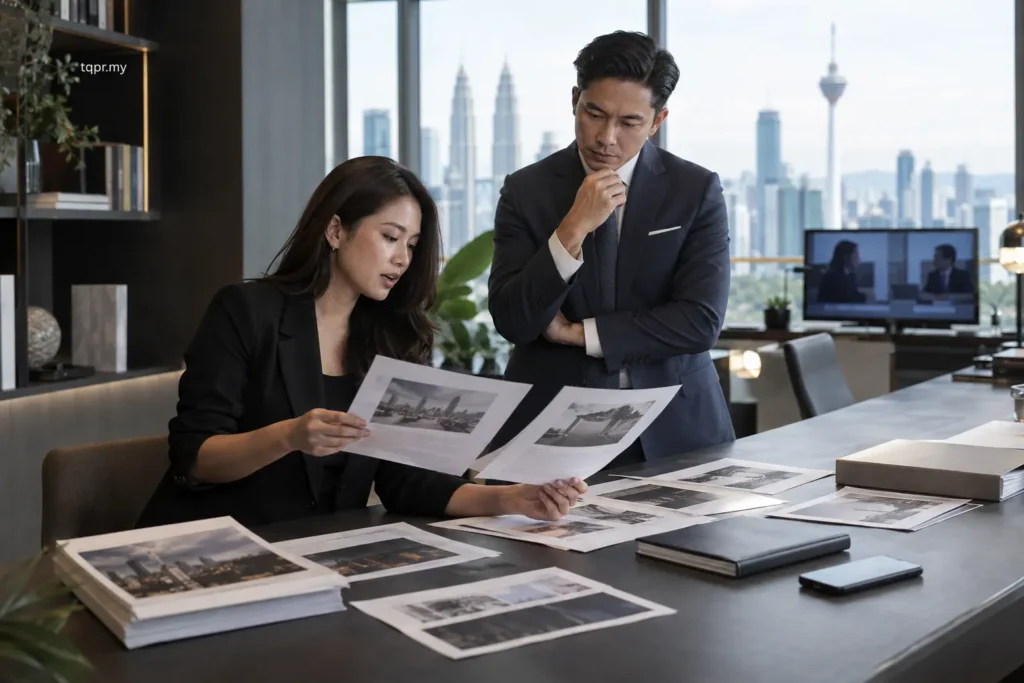
Research is not about finding ways to flatter the interviewer. It helps the spokesperson understand the type of conversation they are entering.
When you prepare for a media interview, review:
- The journalist’s recent coverage of the company, sector and issue
- The outlet’s audience and editorial focus
- The tone and depth of comparable interviews
- Previous reporting on competitors or related controversies
- Current developments that may change the angle
- How technical terms are normally explained to that audience
Look beyond the journalist’s biography. Read or watch complete pieces. Headlines alone do not show how the journalist structures questions or handles evidence.
Check the wider information environment as well. A scheduled interview about growth may shift towards job losses, pricing, regulation or a competitor announcement if the news changes that morning.
A media relations agency can help brief the spokesperson on outlet fit, likely editorial interest and recent coverage. However, the spokesperson should still understand the context personally. Reading the briefing five minutes before the call is not enough for a sensitive interview.
Avoid labelling a journalist as friendly or hostile. A journalist who has previously covered the organisation positively may still ask difficult questions. A sceptical question can also give the spokesperson a legitimate opportunity to explain the facts clearly.
4. Build Three Messages With Supporting Proof
Most interviews do not need ten priority messages. Choose a central position and up to three supporting points. Each message should answer an audience question and carry evidence.
A strong media interview message is short enough to say naturally, specific enough to be useful and well supported enough to survive a follow-up question.
A practical structure is:
- Position: What is the clearest accurate point?
- Reason: Why does it matter?
- Proof: What fact, example or action supports it?
- Relevance: What does it mean for the audience?
For example, “We are committed to customers” is too broad. A stronger answer explains the specific action, time frame, responsible team and effect on customers.
Use a message house if the organisation needs to align several executives or departments. A message house can organise the central position, supporting pillars, proof points and language boundaries before the interview briefing begins.
To prepare for a media interview without sounding scripted, write messages as short ideas rather than polished paragraphs. The spokesperson should be able to explain each point in their own words.
Select proof that can withstand scrutiny:
- Current data with its date and source
- Relevant Malaysian examples
- Clear operational actions
- Approved case studies
- Expert qualifications
- Independent certifications or standards
- Timelines and measurable commitments
Remove decorative statistics that do not help the audience understand the story. Too many numbers make answers harder to recall and easier to confuse.
5. Verify Facts, Boundaries and Approval Lines
A spokesperson should know more than the message. They need to know which facts are confirmed, which are still being checked and which subjects they are not authorised to discuss.
Create a short fact sheet containing:
- Official names, dates and locations
- Current leadership titles
- Product or service details relevant to the story
- Financial or performance figures approved for use
- Malaysian and regional distinctions
- Previous public statements that may be raised
- Commitments and next steps
- Contact details for follow-up information
The media interview fact sheet should identify the owner and date of every important figure. This prevents an old statistic or regional estimate from being presented as a current Malaysian fact.
When you prepare for a media interview, label uncertainty honestly. There is an important difference between:
- “We do not know yet.”
- “The information is being verified.”
- “That information is confidential.”
- “I am not the right person to answer that.”
- “The matter is subject to a legal or regulatory process.”
These lines should not become automatic escape routes. If useful information can be provided, give it. If the spokesperson cannot answer, explain the boundary briefly and offer an appropriate next step where possible.
Confirm who can approve a new response if the situation changes on interview day. This is particularly important for listed companies, regulated sectors, sensitive employee matters and crisis situations.
The team should also review whether previous corporate materials conflict with the current position. Corporate communications support can help align leadership messages, proof points and stakeholder communication before a high-profile interview creates a public inconsistency.
6. Build a Difficult-Question Map
The questions that make the spokesperson uncomfortable are usually the questions that deserve the most preparation.
List likely questions under four groups:
- Expected: Questions clearly connected to the announced topic
- Challenging: Questions about performance, criticism, delays or competitors
- Sensitive: Legal, employee, safety, regulatory or confidential matters
- Unexpected: Broader industry, political, social or hypothetical questions
This media interview question map should reflect the journalist’s likely perspective, not only the organisation’s internal concerns.
To prepare for a media interview, examine what a reasonable sceptic would ask. Review complaints, earlier incidents, inconsistent claims and gaps between the company’s position and available evidence.
For each major question, decide:
- What is the direct answer?
- What context is necessary?
- What evidence supports the answer?
- Which priority message is genuinely relevant?
- What must not be guessed or disclosed?
- Who owns any follow-up information?
Be careful with loaded questions. If the question contains a false assumption, correct the premise calmly before answering. Do not repeat damaging language unnecessarily, and do not attack the interviewer for asking.
Hypothetical questions require judgement. A spokesperson can explain the organisation’s policy or decision process without speculating about an event that has not occurred.
For active reputation issues, connect the interview preparation to the organisation’s crisis communications process. A single interview should not operate separately from stakeholder updates, legal review, operational action and internal communication.
7. Rehearse Answers Aloud Under Real Conditions
Reading notes silently can create false confidence. The spokesperson may understand every point on paper and still struggle to express it clearly when interrupted or challenged.
Rehearse aloud. Use the likely interview format, time limit and language. If the interview is virtual, practise on camera. If it is a live radio slot, rehearse without visual prompts. If it is a print interview, practise longer answers and follow-up questions.
When you prepare for a media interview through rehearsal, assess:
- Whether the first sentence answers the question
- How quickly the main point appears
- Whether proof is clear and accurate
- Whether the answer uses unnecessary jargon
- Whether the response creates an avoidable new problem
- Whether the spokesperson sounds defensive or dismissive
- Whether the answer fits the available time
- Whether the spokesperson can stop speaking once the answer is complete
Do not memorise complete answers. Memorisation can make the delivery brittle. If the journalist changes one word, the spokesperson may search for the rehearsed script rather than listen to the question.
Practise variations instead. Ask the same issue in several ways, interrupt a long answer and follow up on weak evidence. The goal is flexible command of the material.
The existing TQPR guide to what happens during spokesperson media training explains the fuller training process, including simulations, playback and prioritised feedback. For a high-stakes interview, a quick internal run-through may not provide enough pressure or independent challenge.
8. Prepare Delivery, Appearance and Technical Details
Message quality comes first, but practical details can still damage a strong answer. A failed connection, distracting background or late arrival creates pressure before the first question.
Complete the media interview logistics early so the final rehearsal can focus on answers, not preventable technical issues.
For an in-person interview:
- Confirm location, arrival time, security and parking
- Bring necessary identification and approved supporting material
- Choose professional clothing appropriate to the organisation and format
- Avoid visually distracting patterns for television
- Remove noisy jewellery or objects that may affect audio
- Arrive early enough to settle without rushing
For a virtual interview:
- Test the platform, camera, microphone and connection
- Use a stable device and power source
- Position the camera at eye level
- Use clear front lighting and an appropriate background
- Silence notifications and unnecessary applications
- Keep a phone contact available if the connection fails
For broadcast, ask where to look and whether the interview is live or recorded. Follow the producer’s instructions. Do not assume recording has stopped until the production team confirms it.
To prepare for a media interview in another language, rehearse in that language. Translating mentally during the live conversation increases hesitation and may change the meaning of technical or sensitive terms. Prepare an approved terminology sheet for names, claims and specialised language.
Keep notes short. A one-page briefing is usually more usable than a thick folder. Notes should support recall, not become a script that prevents eye contact and listening.
9. Manage the Interview and Follow-Up Professionally
Preparation continues during the interview. Listen to the complete question, pause briefly if needed and give the direct answer first.
During a media interview, a short pause is usually safer than an immediate answer built on an unverified assumption.
If the question is unclear, ask for clarification. If it contains several parts, answer them in a logical order or ask which part the journalist wants addressed first.
Use bridging only after answering. A bridge should connect to a relevant point, not drag every question back to a campaign slogan. For example:
“Yes, the rollout was delayed by two weeks. The important point for customers is that testing is now complete, and the revised launch date is 15 October.”
This answer acknowledges the issue, gives a verified fact and explains the consequence. It does not pretend the delay never happened.
Avoid:
- Guessing when the fact is not known
- Arguing over the wording of every question
- Filling silence with unnecessary information
- Speaking outside your area of expertise
- Criticising individuals or competitors casually
- Sharing confidential information to appear helpful
- Saying “no comment” when a truthful boundary can be explained
- Assuming a casual remark is automatically unusable
If interview conditions such as background, off-the-record or embargoed information are relevant, agree on them clearly with the journalist before providing the information. Media practices can vary, and vague assumptions create risk. When in doubt, keep the discussion to information that can be reported.
After the interview, record any promised follow-up. Send verified documents or clarifications promptly through the agreed contact. Do not use follow-up as an opportunity to replace every answer or pressure the journalist into favourable coverage.
If the organisation gave a factual error, correct it quickly and clearly. If the published story contains a material factual error, raise it professionally with evidence. Disagreement over tone, emphasis or an unfavourable but accurate quote is not automatically an error.
How to Prepare for Different Interview Formats
The core preparation remains the same, but each format changes how the spokesperson should use time and detail.
The media interview format determines the ideal answer length, level of detail and rehearsal conditions.
| Format | Preparation priority | Common risk |
| Live television | Short answers, clear opening line and visual composure | Long answers that are interrupted |
| Recorded television | Complete, self-contained soundbites | Assuming an answer can always be restarted |
| Radio | Voice, pace and verbal clarity | Relying on visual cues or technical jargon |
| Podcast | Structure, examples and conversational depth | Becoming too informal or speculative |
| Print or online interview | Evidence, context and follow-up detail | Overexplaining before answering directly |
| Written Q&A | Precise wording and coordinated approval | Producing promotional copy that avoids the question |
| Press conference | Prioritisation, repetition tolerance and multi-journalist control | Reacting defensively to repeated questions |
| Virtual interview | Technical reliability and camera setup | Connection failure, poor audio or distraction |
When you prepare for a media interview, ask how the material is likely to be used. A short broadcast clip rewards concise answers. A specialist feature may require evidence and nuance. Adapt the depth without changing the underlying facts.
Malaysia-Specific Media Interview Considerations
Choose the Right Language
The most senior executive is not always the strongest spokesperson in every language. Choose someone who can explain the issue naturally and accurately to the outlet’s audience.
For a Malaysian media interview, language ability should be assessed together with subject knowledge and authority to speak.
If the spokesperson will answer in English and Bahasa Malaysia, prepare the key messages, figures and sensitive terms in both. For Mandarin or other language interviews, use a qualified reviewer familiar with the business context rather than relying only on literal translation.
Separate Malaysian Facts From Regional Claims
Regional spokespeople may use ASEAN or Asia-Pacific data that does not describe Malaysia accurately. Label the geography of every figure and example. If local data is unavailable, say so rather than presenting a regional number as Malaysian.
Add Local Relevance
Explain why the topic matters to Malaysian customers, employees, businesses or communities. Avoid dropping a global announcement into the market with no local consequence.
Respect Approval and Regulatory Requirements
Listed companies and regulated sectors may have disclosure, advertising or confidentiality obligations. Interview preparation should involve the appropriate internal specialist without turning every answer into legal language.
Prepare for Different Newsroom Needs
Business, mainstream, trade and broadcast journalists may approach the same announcement differently. The facts should remain stable, while the explanation adapts to audience knowledge and editorial interest.
A 24-Hour Media Interview Checklist
Use this short checklist to confirm readiness.
Interview Context
- Outlet, journalist, topic and audience confirmed
- Format, location, language and duration confirmed
- Live, recorded or written status confirmed
- Publication timing and follow-up deadline understood
Message and Evidence
- One interview objective agreed
- Three priority messages prepared
- Proof points verified and dated
- Malaysian and regional facts clearly separated
- Difficult questions rehearsed
- Unknown, confidential and specialist-answer boundaries agreed
Spokesperson Readiness
- Answers rehearsed aloud
- Technical language simplified
- Interview-day owner and PR contact confirmed
- Clothing, travel or virtual setup prepared
- One-page briefing ready
After the Interview
- Follow-up commitments recorded
- Supporting materials ready to send
- Internal monitoring and escalation owner identified
If several items remain unresolved, reconsider whether the spokesperson is ready. A short delay may be better than an interview built on unverified information, although breaking news and crisis situations may require a faster holding response.
Common Mistakes When Preparing for a Media Interview
Preparing Only the Opening Statement
The interview becomes difficult after the obvious first question. Prepare follow-ups and challenge the evidence behind each claim.
A media interview rarely follows the organisation’s preferred sequence, so the spokesperson must be ready to enter the subject from several angles.
Memorising Corporate Paragraphs
Polished copy rarely sounds natural when spoken. Prepare ideas, proof and answer structures instead.
Treating Bridging as Avoidance
A spokesperson should answer the question before connecting it to a relevant message. Repeatedly ignoring reasonable questions damages credibility.
Using Too Many Messages
If everything is important, nothing will be remembered. Limit the interview to the few points that serve the audience and objective.
Assuming Confidence Equals Readiness
A confident executive can still use outdated facts, speculate or create an unnecessary headline. Subject knowledge, message judgement and rehearsal all matter.
Ignoring the Wider News Context
An interview angle can change quickly. Check relevant developments again shortly before the conversation.
Rehearsing Only Comfortable Questions
Preparation should expose weak answers before the journalist does. Include criticism, contradictions and sensitive topics.
Overcorrecting Natural Behaviour
The goal is not to turn the spokesperson into a television presenter. Address delivery habits only when they interfere with clarity, credibility or attention.
When Is Professional Media Training Worth It?
An internal briefing may be sufficient for an experienced spokesperson handling a low-risk, familiar subject. Professional training becomes more valuable when:
- The spokesperson has limited interview experience
- The interview is live or high-profile
- The subject involves legal, safety, regulatory or reputation risk
- Several spokespeople must remain aligned
- The organisation is announcing a major change
- The journalist is investigating criticism or an incident
- The interview may take place in multiple languages
- Previous interviews produced unclear or damaging coverage
- The spokesperson knows the subject but struggles to explain it simply
Formal preparation should use realistic questions and individual practice. It should improve judgement, not teach the participant to dodge scrutiny.
The higher the media interview risk, the more valuable independent challenge and recorded rehearsal become.
Frequently Asked Questions
How far in advance should you prepare for a media interview?
Begin as soon as the request arrives. Routine interviews may need several hours of focused preparation, while major announcements or sensitive interviews may require days of fact-checking, approvals and rehearsal. Breaking news may compress the timeline, making a current message framework and trained spokesperson especially valuable.
Should a spokesperson ask for the questions beforehand?
The PR team can ask for the topic, angle and likely areas of discussion. Some journalists may share questions, while others will not. The spokesperson should be able to handle reasonable follow-ups rather than relying on a fixed list.
How many key messages should an interview have?
Usually one central position and up to three supporting messages are enough. Each should have relevant evidence and a clear connection to the audience.
Should you memorise answers before a media interview?
No. Memorise the facts, messages and boundaries, not complete paragraphs. Rehearse several ways to explain the same point so the delivery remains natural.
What should you say if you do not know the answer?
Say that you do not have the verified information and offer to check where appropriate. Do not guess. If another qualified person owns the subject, explain that clearly.
Is anything really off the record?
Do not assume it is. Any special interview condition should be explicitly discussed and agreed with the journalist before the information is shared. If the boundary is unclear, speak only from information that can be reported.
Can a spokesperson review the article before publication?
Journalists are generally not required to provide full copy for approval. They may verify facts, quotations or technical points at their discretion. The organisation can provide accurate follow-up material, but should not expect editorial control.
What is the difference between interview preparation and media training?
Interview preparation focuses on one specific opportunity, including its journalist, audience, messages, facts, risks and logistics. Media training develops broader spokesperson capability through instruction, simulations, feedback and repeated practice.
Prepare for the Interview, Not a Perfect Performance
To prepare for a media interview effectively, prioritise clarity, verified facts, useful evidence and realistic rehearsal. The objective is not to eliminate every pause or produce perfectly polished answers.
A credible spokesperson listens, answers the question and knows the limits of what can responsibly be said. That combination is more valuable than sounding rehearsed while avoiding the issue.
If your organisation needs media interview preparation, realistic simulations or a broader spokesperson-readiness programme, contact TQPR Malaysia to discuss the interview, audience and risk level.