
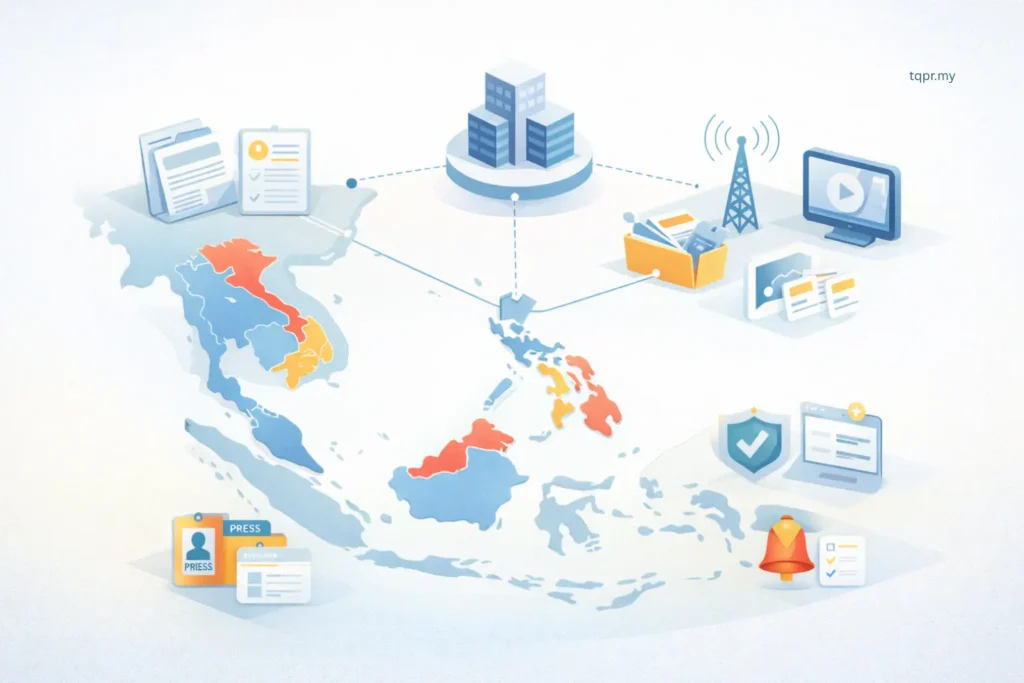
Running PR across Malaysia, Thailand, and Vietnam is not “one press release, three translations.” You need one regional narrative, three local market playbooks, and a tight approval system built on message house strategy and development that still lets country leads move fast. The goal is consistent earned media and reputation lift, measured by share of voice, sentiment, and referral traffic, without flattening local tone or platform habits.
Key Takeaways: Multi-Market PR Planning in Southeast Asia
- Build one regional strategy hub, then execute through country leads who own language, media customs, and day-to-day relationships.
- Set shared regional KPIs, then add country targets so Malaysia, Thailand, and Vietnam can be judged fairly.
- Localize beyond translation: tone, proof points, spokesperson selection, and content formats must change by market.
- Align earned, owned, and paid so coverage converts into social proof, search demand, and measurable referrals.
- Run weekly performance pivots using a single dashboard and a short market feedback loop from journalists and creators.
- Put risk controls in the plan early: claims review, influencer disclosure rules, and crisis triggers by country.
Rapid Multi-Market PR Playbook: Goals, KPIs, Governance
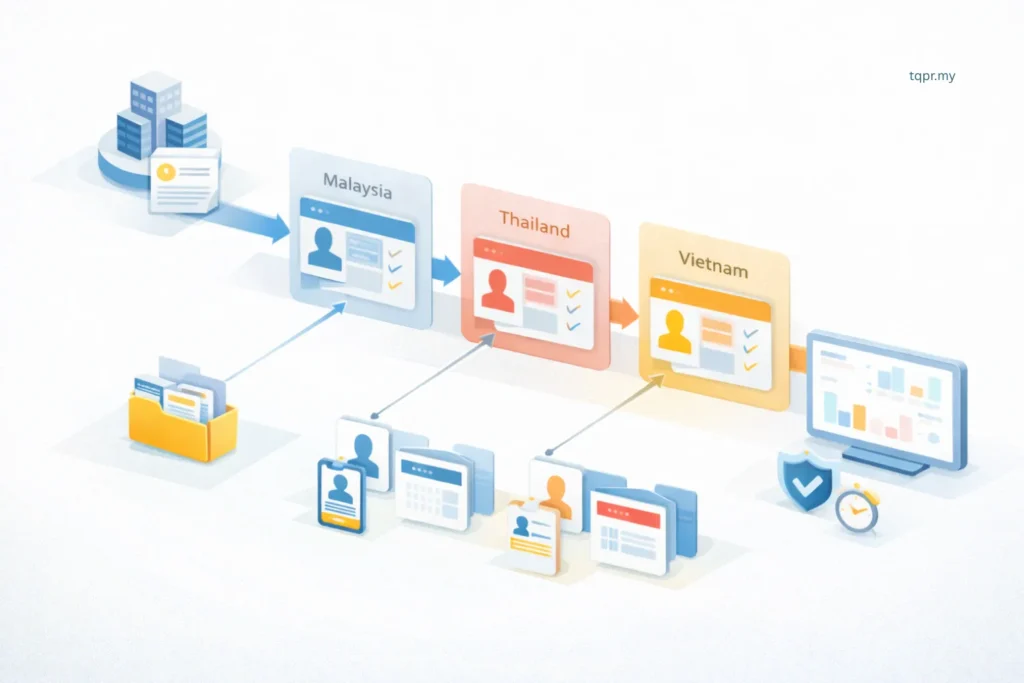
A workable multi-market PR program is two systems running together: a central system for consistency, and a local system for credibility.
Central system (regional hub) should own:
- Regional story and positioning, including what the brand will not claim
- Core message pillars and proof points
- Shared media kit folder structure and version control
- Measurement definitions (what counts as a “placement,” how SOV is calculated, sentiment rules)
- Approval rules and response timelines (who signs off what, by when)
For newsroom-ready structure, base your core pack on our press release Malaysia checklist, then localise per market.
Local system (country leads) should own:
- Country media list, journalist preferences, and outreach rhythm
- Language and tone adaptation, including sensitive topics and phrasing to avoid
- Local spokesperson readiness, interview coaching, and context notes
- Platform and format choices that match local consumption
- Local partner management (agencies, creators, community orgs)
Minimum governance you need to avoid chaos:
- One “single source of truth” doc for the current narrative, top messages, and approved facts
- One approvals channel, with named decision makers and a defined backup
- A rule that nothing “new” gets published without passing the same claims check in every market
Country Media Profiles: Malaysia, Thailand, Vietnam
You do not need a thesis on each market. You need a practical profile you can use to plan outreach, assets, and spokesperson prep.
Malaysia
Malaysia is multilingual and segmented. If Malaysia is a priority market, use our PR in Malaysia field guide to map language, outlets, and region split. Business and corporate desks often work comfortably in English, but mass reach typically needs local language sensitivity and culturally neutral wording that does not alienate any major group.
What to plan for:
- Language variants, not just translation
- A clean “bilingual pack” workflow if you are running both English and Malay outreach
- Strong clarity on local proof points: what matters to Malaysians in their daily life, not what sounds impressive regionally
Thailand
Thailand tends to reward Thai-first delivery and locally natural phrasing. Regional brand language that feels “imported” can underperform, even when the facts are strong.
What to plan for:
- Thai-first messaging and spokesperson support
- Social formats that fit local creator styles, not just global brand templates
More emphasis on trust and relationship pacing with media and KOLs
Vietnam
Vietnam often responds better when you provide more context up front. If your story assumes the audience already knows your category or your company, you may lose them early.
What to plan for:
- Clear explainers and backgrounders that editors can lift quickly
- Community and institutional credibility signals when relevant (partners, programs, safeguards)
- Strong local spokesperson context so interviews do not feel generic
Localization That Actually Works: Language, Culture, Media Customs
Localization is a system, not a creative afterthought. If you treat it like “translate and ship,” you will create inconsistencies that journalists notice immediately.
A simple localization workflow that scales:
- Regional hub locks the “non-negotiables”
Core narrative, approved claims, numbers, product facts, and what is off-limits. - Country lead writes the local entry point
Same story, different entry point. Local pain points, local proof, local examples. - Linguistic review plus cultural pass
Not just grammar. Check tone, implied meaning, and sensitive phrasing. - Editorial format pass
Does this read like something local media would publish? If not, rewrite the structure. - Spokesperson prep notes
Give each market a short “how to answer” sheet that matches local expectations.
Channel Strategy by Market: Press, Social, Influencers, Communities
Do not force a single channel template across all three markets. Build one regional channel map, then select per-country priorities.
Earned (press, interviews, features):
- Use the same message pillars across markets
- Change your pitch angle and the proof points
- Keep one shared asset folder, but allow local leads to add localized visuals and examples
Owned (website, newsroom page, LinkedIn, brand socials):
- Create one regional landing page structure
- Add localized sections per country with local FAQs, local spokespeople, and local case proof
Paid (boosts, content distribution, creator whitelisting where appropriate):
- Use paid to amplify what already performed organically
- Avoid paid that tries to “force” weak angles into credibility
Influencers and community:
- Use a tiered approach (nano, micro, mid, macro) based on trust, not only reach
- Track creator output for message accuracy, not just views
- Build longer-term creator relationships in each market through influencer management instead of one-off bursts
If you’re deciding between formats, align your rollout with the PR format in Malaysia so you can compare outcomes properly.
Regulatory and Reputational Risk Controls by Country
Multi-market PR fails fastest when teams ship claims that are technically true but locally risky, or when influencer arrangements become credibility liabilities. For escalation hygiene, keep a first-24-hours checklist ready (crisis communications and public relations in Malaysia).
Build a risk checklist into your workflow:
- Claims review: what needs legal, what needs compliance, what needs internal fact owners
- Disclosure rules for creators and partners, documented in writing
- “Stop and escalate” triggers for sensitive topics, backlash, or misinformation spikes
- Local language risk review, especially for phrases that can be read as disrespectful or dismissive
Keep this simple and repeatable. If it is too complex, people will bypass it.
Measurement and Scaling: Unified Metrics, Dashboards, Market Tests
You need a unified measurement framework so you can compare performance across markets, but you also need country context so you do not punish the wrong team for the wrong reasons.
Regional KPIs that usually work across Malaysia, Thailand, and Vietnam:
- Share of voice within your category (with a defined competitor set)
- Sentiment trend, with a simple rule set for classification
- Placement quality (outlet tiering, message pull-through, and accuracy)
- Referral traffic to key pages, split by market and campaign
- Creator performance tied to business signals (clicks, saves, inquiries), not vanity views
Weekly cadence that keeps you fast:
- One weekly regional review: what moved, what did not, and why
- One country-level correction list: top message gaps, top objections, top format wins
- One decision list: what you will double down on next week, and what you will stop doing
If you need a rollout template, adapt our 90-day PR timeline for Malaysia into a three-market sprint plan.
Market tests that reduce risk:
Pilot one city or one cluster first in each market, measure response, then scale. You will learn faster and waste less budget.
If you want a clean scoring approach, use our Public Relations KPIs in Malaysia guide and replicate the same logic for Thailand and Vietnam.
FAQ: Multi-Market PR Planning for Southeast Asia
What makes multi-market PR planning different from doing PR in one country?
The complexity is not the number of markets. It is the number of approvals, languages, media customs, and risk profiles you must manage without losing speed.
Do I need a local agency in every market?
Not always, but you do need local capability. If you cannot write and pitch naturally in-market, you will move slower and get lower-quality coverage.
How do you avoid inconsistent messaging across markets?
Use one regional source of truth, lock non-negotiables, and let country leads localize angles and formats within those boundaries.
What should I track if I want PR to tie to growth?
Track referral traffic, search lift around branded and category terms, and inquiries that correlate with high-quality placements. Keep it consistent for at least a quarter so trends are real.
Final Word: Multi-Market PR That Scales Across SEA
Multi-market public relations planning for Southeast Asia works when you combine tight governance with real local autonomy. Keep one regional narrative, build three country playbooks for Malaysia, Thailand, and Vietnam, and run weekly measurement pivots that reward what performs. Localize beyond translation, align earned, owned, and paid, and treat risk controls as part of execution, not a last-minute step.
If you want this turned into a working governance kit and dashboard, talk to a team that runs Southeast Asia PR planning end-to-end.