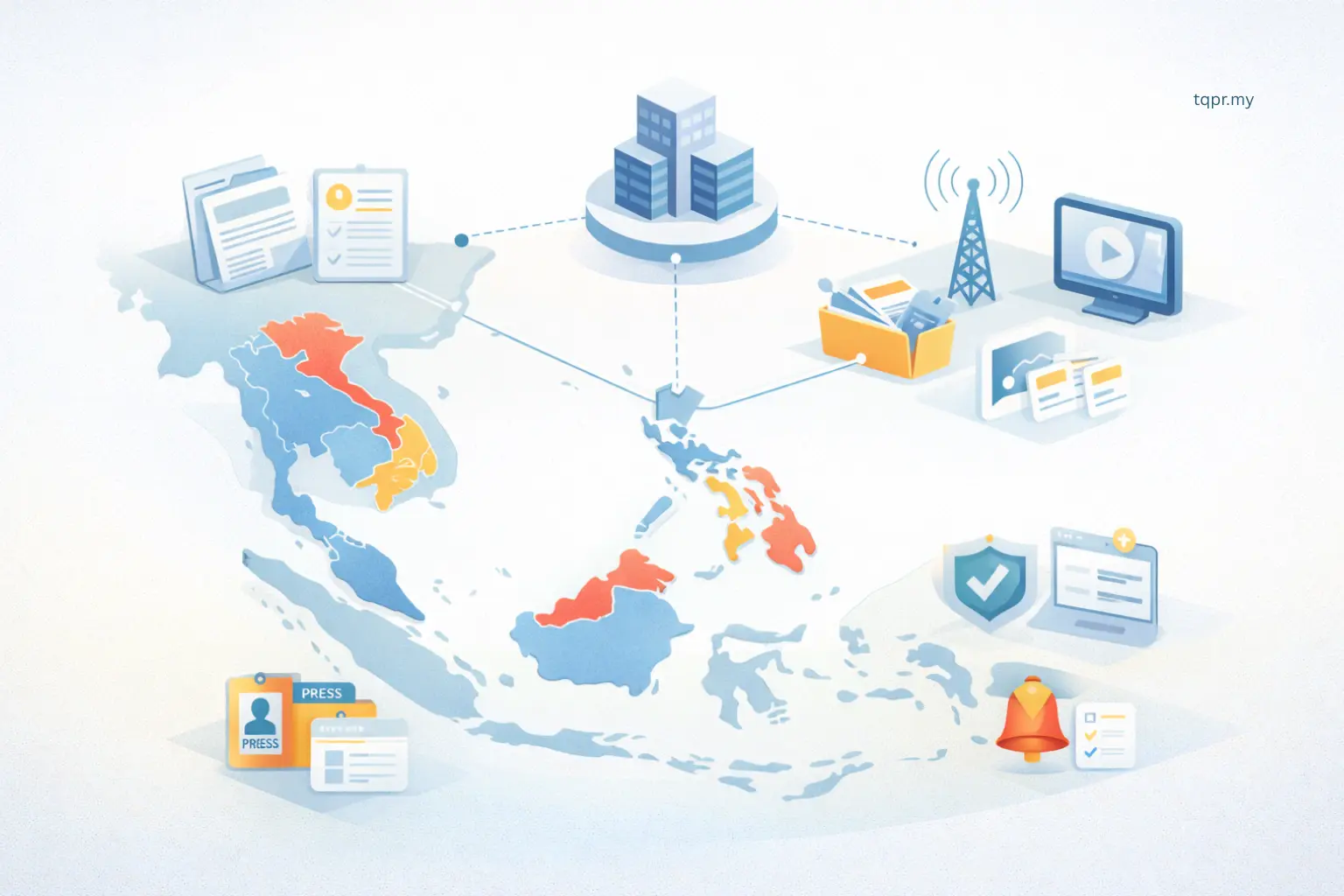
Public Relations KPIs in Malaysia work best when they measure business impact, not noise. If you’re still mapping outlets, language, and region split, start with our PR in Malaysia field guide first. If your PR dashboard only shows raw mentions, you will reward low-quality coverage and miss what actually builds awareness, credibility, and consideration in the Malaysia market without business intel, media monitoring and reporting. The practical approach is simple: set earned media targets by channel, weight coverage by outlet influence and audience fit, track share of voice against real competitors, and connect coverage spikes to search and web signals so you know when PR actually moved the needle.
This guide breaks down realistic earned media targets in Malaysia, what each KPI means, and how to report them in a way your team and stakeholders can act on.
Public Relations KPIs in Malaysia: Key Takeaways
- Use a small set of core PR metrics in Malaysia: mentions, weighted reach, share of voice, and sentiment, then add web and search signals for proof.
- Set earned media targets by channel and outlet tier, not one big monthly number.
- Score coverage by outlet influence, geography, and audience fit so one high-value placement can beat twenty low-impact mentions.
- Report weekly for pacing, monthly for decisions, and tighten monitoring during launches or reputation issues.
- For launches, tighten the cadence and run it like a sprint, similar to a 90-day PR launch plan in Malaysia.

Quick Playbook: Realistic Earned Media Targets for Malaysia
If you want earned media targets that stay realistic, start by defining what “good” looks like in Malaysia, then measure it consistently.
- Pick your channels and outlet tiers first
Separate online news, broadcast, radio, print, podcasts, and social. Then split outlets into tiers (top-tier national, mid-tier, niche or trade, regional). This makes your targets defendable because different channels behave differently in Malaysia. - Set targets based on capacity, not hope
Targets should match your resources, your newsworthiness, and your campaign cadence. A lean team will do better with fewer, higher-quality placements plus consistent mid-tier coverage, rather than chasing volume. - Use weighted scoring to avoid vanity wins
Raw mention counts inflate easily. Weighted reach and placement scoring help you prioritise the coverage that matters. Your scores are only as good as your inputs. - Link PR results to outcomes
A Malaysia PR KPI framework should include at least one “downstream” signal like branded search lift, referral traffic, enquiry volume, or demo requests, depending on the business. If you want a proper structure that maps outputs to outcomes, use the AMEC Integrated Evaluation Framework as your reference.
Align Public Relations KPIs in Malaysia to Business Goals
Before choosing numbers, decide what you are trying to achieve.
Awareness KPIs in Malaysia usually focus on share of voice, weighted reach, and consistent pickup in the right outlets.
Credibility KPIs focus on sentiment, message accuracy, and the tier quality of coverage.
Consideration KPIs connect earned coverage to referral traffic, branded search interest, and meaningful actions like enquiries, sign-ups, or calls.
This alignment matters because “more mentions” can be a bad outcome if the tone is negative, the outlets are irrelevant, or the story is off-message.
The Core PR Metrics Malaysia Teams Should Track
Here are the core public relations KPIs in Malaysia that stay useful across most industries.
1) Earned Media Mentions
Mentions are the simplest KPI. Track them by channel and outlet tier, not as one lump number. Mentions are best used for pacing and momentum, not as the final score. If message accuracy is slipping, fix the inputs: use our press release Malaysia checklist to tighten the facts package journalists copy.
What to track:
- Mentions by channel (online, TV, radio, print, podcast, social)
- Mentions by outlet tier (top-tier, mid-tier, niche or trade, regional)
- Message accuracy rate (whether core claims are reported correctly)
2) Weighted Reach (Estimated Potential Audience)
This is your “reach with context” KPI. Instead of counting mentions equally, you assign weight based on outlet influence. You can estimate this using each outlet’s publicly available audience signals or your monitoring tool’s reach estimates.
A practical formula:
Weighted reach = placement weight x outlet reach estimate
Keep it consistent. The goal is comparison over time, not perfect precision.
3) Share of Voice in Malaysia
Share of voice (SOV) tells you how visible you are compared to competitors. This is one of the most defensible PR metrics in Malaysia because it forces context.
4) Sentiment and Risk Signals
A basic approach:
- Choose 3 to 5 competitors
- Track mentions for you vs competitors within the same keyword set and category
- Report SOV by month, and by channel if possible
Sentiment matters more in Malaysia when your topic touches regulation, safety, sensitive public issues, or trust-heavy categories. Track sentiment directionally, then review the actual clips behind the score so you do not trust automation blindly.
Track:
- Positive, neutral, negative split
- Top negative themes
- Response time and correction time when something is inaccurate
Set Malaysia-Specific Targets by Outlet Tier and Channel
Instead of giving one “Malaysia benchmark,” set targets by tier and channel, especially once you split Peninsular vs East Malaysia (see PR in Malaysia field guide). If your plan includes briefings or interviews, align KPIs to format using PR format in Malaysia so you don’t compare apples to oranges. This is how you avoid unrealistic expectations.
A practical target structure:
- Top-tier national outlets: fewer placements, higher value, higher message discipline
- Mid-tier outlets: steady monthly cadence, easier to maintain consistency
- Niche and trade: high relevance for B2B and specialised categories
- Regional outlets: important if your campaign needs Penang, Johor, Sabah, or Sarawak coverage specifically
Your reporting becomes clearer because you can say: we hit our mid-tier cadence, we landed two top-tier stories, and we improved SOV in business media, instead of arguing about raw totals.
How to Score Coverage in Malaysia (Outlet Influence, Geography, Audience Fit)

If you want a simple scoring system that does not feel like academic theory, use three multipliers.
A) Outlet influence score
Higher for outlets that consistently shape category narratives.
B) Geography weight
Boost coverage in the states and cities that matter to your business goals.
C) Audience fit score
Higher when the outlet matches your buyer persona. Trade outlets can score higher than general news if you are B2B.
A simple scoring method:
Placement score = outlet influence x geography weight x audience fit
This turns earned media measurement in Malaysia into something you can operationalise, not just report.
Track and Report PR KPIs in Malaysia with Dashboards
A PR dashboard Malaysia teams actually use needs filtering. If everything is blended together, you cannot act. Different formats produce different signals, so keep notes on what you ran (event, briefing, one-on-one).
Minimum dashboard filters:
- Channel
- Outlet tier
- Geography
- Sentiment
- Campaign tag or topic tag
Suggested cadence:
- Weekly: pacing, outreach adjustments, angle performance
- Monthly: SOV movement, weighted reach trend, story quality, next-month targets
- Daily during launches or issues: spikes, negative themes, correction needs
Use KPI Insights to Optimise Outreach and Budget
Once you have two to three months of data, you can start optimising properly.
What to do with insights:
- Double down on beats and outlets that drive referral traffic or branded search lift
- Reduce effort on outlets that generate volume but weak reach, weak fit, or poor message accuracy
- Improve your press kit and spokesperson media and message training using the most repeated journalist questions
- Build a shortlist of outlets that consistently deliver quality, and treat them as long-term relationships
This is how PR KPIs in Malaysia become a decision tool, not a report you send and forget.
FAQ: Public Relations KPIs in Malaysia
What are the KPIs for PR in Malaysia?
The most useful public relations KPIs in Malaysia are earned mentions by channel and tier, weighted reach, share of voice against competitors, sentiment, message accuracy, and at least one business outcome signal like referral traffic, branded search lift, or enquiries.
What is considered earned media in public relations?
Earned media is coverage you did not pay to place, including news articles, interviews, broadcast mentions, organic social pickup, and independent reviews. In Malaysia, it is best tracked by channel and outlet tier so you can separate meaningful coverage from low-impact mentions.
What are the five KPI examples most teams should start with?
Mentions, weighted reach, share of voice, sentiment, and referral traffic from earned coverage. If you can only track five, start here and keep them consistent for trend comparison.
How do you measure PR beyond clippings?
Use share of voice, weighted scoring, message accuracy, and downstream outcomes like search interest and web actions. That combination shows whether earned media targets in Malaysia are translating into real market traction.
Final Word: Public Relations KPIs in Malaysia You Can Defend
Public Relations KPIs in Malaysia should be realistic, measurable, and tied to outcomes. Track a tight KPI set, score coverage instead of counting it blindly, and report in a cadence that lets you adjust outreach quickly. When you measure mentions with weighted reach, share of voice, sentiment, and business signals, you stop chasing vanity coverage and start building earned media momentum you can actually defend.
Want a dashboard your team can run weekly without overthinking? Share your current monitoring setup (even if it’s just Google Alerts + Sheets) and we’ll map the exact dashboard columns and scoring weights. If you want this turned into a working dashboard with scoring rules, talk to a team that runs Malaysia PR measurement and reporting end-to-end.