
A social media backlash becomes a reputation crisis when the story stops being “a loud comment section” and starts creating real stakeholder risk. In practice, that shift shows up as a sustained negative narrative across platforms, credible allegations, third-party amplification, and early signs of commercial or operational fallout. This Social Media Backlash to Reputation Crisis framework is a practical public relations response framework that gives you a clear way to triage the first 24 hours, contain damage, escalate with discipline, and recover trust through issues and crisis training/management instead of improvising under pressure.
Key Takeaways: Social Media Backlash to Reputation Crisis
- Classify the situation using risk, velocity, credibility, and stakeholder impact, not how hostile the comments feel.
- Use business intel, media monitoring and reporting and anomaly alerts to spot cross-platform spread early, then assign one incident owner immediately.
- Post a holding statement quickly, and pin a single “Crisis Facts Post” as your source of truth.
- Pause scheduled marketing and conflicting outbound activity so your messaging does not look disconnected.
- Escalate using predefined triggers and decision rights, not leadership anxiety or internal politics.
- Close with remediation, measurement, and a post-mortem within 1 to 2 weeks, then run drills and update the plan.
When Social Media Backlash to Reputation Crisis Risk Starts
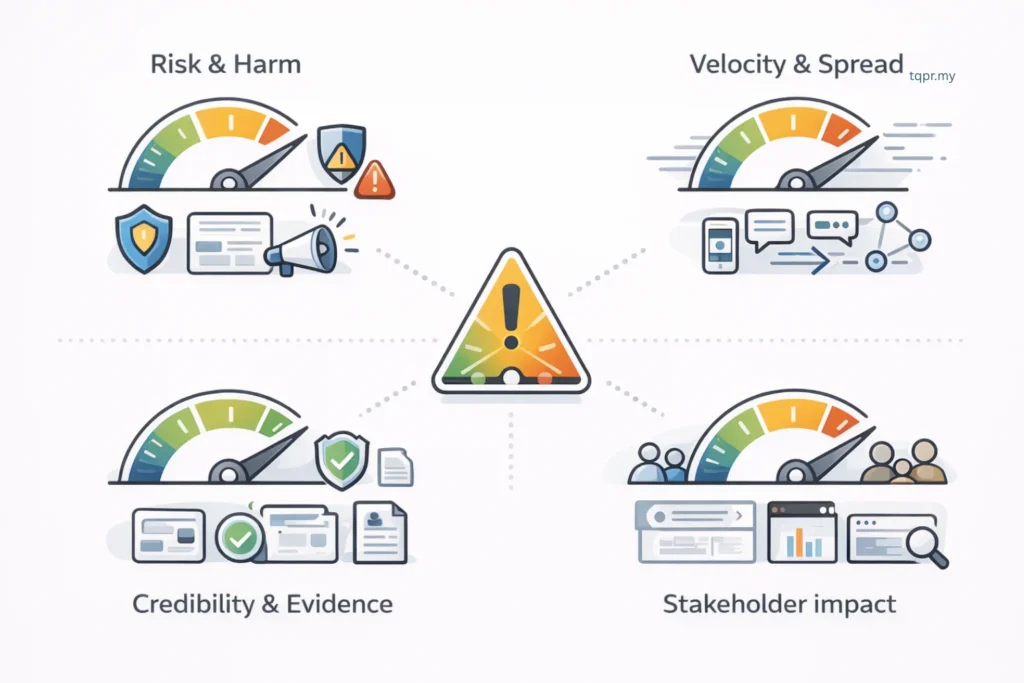
Backlash is common. Crisis is specific. You are in crisis territory when at least one of these is true:
- Harm and credibility: Allegations involve safety, discrimination, privacy, misconduct, or anything with credible evidence (screenshots, recordings, documents).
- Velocity and spread: The narrative sustains and travels across platforms, communities, or languages, and you can no longer contain it within one thread. If you are operating across markets, align on a regional playbook so updates stay consistent.
- Third-party amplification: Journalists, regulators, industry bodies, major creators, partners, or employers are asking questions or sharing the story.
- Stakeholder impact: You see tangible consequences like customer churn, support spikes, staff harassment, partner discomfort, or operational disruptions.
The core shift is loss of control. When you cannot correct the story quickly with verifiable facts, or when the issue threatens stakeholder trust beyond social platforms, treat it as crisis communications and move into a structured response.
Social Media Backlash to Reputation Crisis Checklist
Use this checklist to decide whether you stay in “managed criticism” mode or activate crisis governance. If you tick multiple items, assume elevated risk and respond accordingly.
High-risk content and credibility
- Allegations involve safety, discrimination, privacy, harassment, or misconduct.
- Evidence is circulating and being treated as credible by neutral observers.
- The issue includes identifiable victims or affected customers.
- A legal, regulatory, or formal complaint pathway is plausible.
Spread and stakeholder impact
- The story is active across multiple platforms, not just one thread.
- New audiences are entering (partners, journalists, employees, industry communities).
- Support tickets, refunds, cancellations, or escalations are rising.
- Employees are being targeted, doxxed, or harassed.
- Search results are surfacing the issue prominently, or it is moving into mainstream media.
- You cannot publish at least one verifiable fact soon, or internal facts are fragmented.
Decision rule: If there is credible harm or credible evidence, treat it as a crisis. If it is mostly opinion but spreading fast, treat it as a potential crisis and contain it early.
First 60 Minutes: Social Media Backlash Triage and Containment
Your first hour is about control and clarity. You are building a single source of truth and preventing accidental escalation.
- Declare an incident and assign an incident lead
One person owns coordination, the decision log, and approvals. This prevents multiple teams replying in parallel. - Capture evidence before anything changes
Screenshot the original content, top replies, quote posts, and key reposts. Save URLs and timestamps. Document what is being claimed in one sentence. - Pause risky outbound activity
Pause scheduled marketing, campaign ads that could amplify the wrong content, and any outbound announcements that might look tone-deaf. - Confirm what you know, and what you do not know
Force a simple internal reality check: what is verified, what is alleged, and what is unknown. Do not fill gaps with confident guesses. - Publish a holding statement if risk is rising
A holding statement buys time and shows awareness. It should acknowledge concern, confirm you are reviewing, and commit to an update cadence. - Pin a “Crisis Facts Post” as the source of truth
Create one pinned post (or a short page on your site) that you can update. Keep it factual: what happened (as verified), what you are doing now, and when the next update will be. - Align spokespeople and frontline teams
Customer support, sales, community managers, and leadership need the same approved lines. Give staff a simple instruction: do not improvise, route requests to the official update.
When to Escalate: Quick Triage and Decision Rules
Escalation should be automatic when triggers are met. If you do not already have clear decision rights and rehearsal cadence, build them into an Issues and Crisis Training and Management workflow. Avoid numeric “sentiment thresholds” unless you already have baselines and a consistent way to measure them.
A simple escalation ladder
| Level | What it looks like | Who owns it | What you do |
| Managed criticism | Negative feedback is contained, low harm risk | Social + Support | Reply, resolve, document |
| Backlash with momentum | Cross-platform spread, narrative shifting, partner questions | Comms lead + Ops + Legal as needed | Holding statement, facts post, coordinated updates |
| Reputation crisis | Credible harm claims, proof circulating, media or regulator interest, operational impact | Crisis lead + Exec sponsor + Legal | Spokesperson protocol, stakeholder outreach, frequent updates, remediation plan |
Escalation triggers that should auto-fire
Escalate to “backlash with momentum” or “reputation crisis” if any of these are true:
- Credible safety, discrimination, privacy, or misconduct allegations
- Evidence that is difficult to refute quickly
- Partner or platform actions (delisting, paused collaborations, formal inquiries)
- Journalists asking questions, or the narrative reaching mainstream outlets
- Employee targeting, doxxing, threats, or internal morale risk
- Operations impacted (support surge, cancellations, refunds, service disruptions)
Decision rules that prevent paralysis
- Publish at least one verifiable fact before further commentary when possible. If you do not have facts, acknowledge uncertainty and commit to an update time.
- One approval path for external messaging during the incident. No “side replies” from executives.
- Time-box decisions: holding statement decisions happen fast. Longer statements require verified facts, legal review when appropriate, and a clear owner.
Assemble the Response Team: Roles, Decision Rights, and Spokesperson Protocol
Speed without structure creates contradictions. Structure without speed looks evasive. You need both.
Core roles for a cross-functional response
- Incident Lead: Runs the timeline, tasking, and decision log.
- Comms Lead: Owns narrative, statements, channel strategy, and media relations.
- Social Lead: Publishes updates, monitors, moderates, escalates threats or doxxing.
- Ops or Product Lead: Confirms facts, root cause, and what can change immediately.
- Customer Support Lead: Aligns macros, remedies, refunds, and escalation handling.
- Legal Counsel: Reviews risk, privacy, defamation exposure, and formal inquiries.
- HR or People Lead: Manages internal comms, staff safety, conduct issues.
- Executive Sponsor: Signs off major commitments, policy changes, and high-risk statements.
Decision rights (keep it explicit)
- Social can handle routine negativity using approved macros.
- Comms lead approves crisis messaging and updates cadence.
- Legal reviews when there is clear legal or privacy exposure, not for every reply.
- Executive sponsor signs off on major remedies, policy changes, and any statement that sets a binding commitment.
Spokesperson protocol
- Name one spokesperson and one backup. Everyone else redirects.
- Give the spokesperson a short brief: verified facts, unknowns, actions, and what not to speculate on.
- Decide in advance when you will use video statements. Do not go live under pressure.
Messaging Playbook: What to Say, Where to Post, Tone Guidelines, and Templates
In a backlash, your job is not to debate. Your job is to reduce uncertainty and show control.
Tone guidelines
- Calm, direct, human. No defensiveness, no sarcasm, no blame shifting.
- Acknowledge impact before arguing details.
- Avoid absolutes if facts are incomplete.
- Keep updates consistent in structure so stakeholders know what to expect.
Where to post
- Where it started: Acknowledge in the original thread or post.
- Primary brand channel: Pin the update so it is easy to find.
- A longer-form facts page (optional): Use when the situation needs receipts, timelines, or multiple updates.
- Internal channels: Give staff guidance early to stop improvisation.
Media relations and earned media handling (without overreacting)
If media interest begins, treat it like standard media relations, just faster and more disciplined:
- Prepare a short press line that matches your Crisis Facts Post.
- Keep one owner for media outreach and inbound press queries.
- Choose the right format based on risk and complexity: written statement first, then a virtual briefing or a tightly controlled media one-on-one only when you can support it with verified facts.
- Do not announce a press event to “prove transparency” if your facts are still incomplete.
Templates you can copy and adapt
Holding statement (facts still forming)
“We’re aware of the concerns being shared about [issue]. We’re reviewing what happened and gathering the facts. We will share an update by [timeframe] and will continue updating here. If you are directly affected, contact us so we can route this quickly.”
Crisis Facts Post structure (pin this)
- What we know (verified facts only)
- What we are doing now (immediate actions)
- What we are reviewing (unknowns, investigation steps)
- Support options (where affected people can get help)
- Next update timing (clear cadence)
Correction without escalation (misinformation)
“There’s a claim circulating that [claim]. That is not accurate. Based on what we can verify, [verified fact]. We are sharing this to keep information clear, and we will update again by [timeframe].”
Apology with remediation (when warranted)
“We’re sorry for [specific impact]. We fell short on [specific area]. Here is what we are doing now: [actions]. We will also [longer-term change]. We will share progress updates on [cadence].”
Moderation rules
Remove threats, hate speech, and doxxing. Do not delete criticism just because it is harsh. If you close comments, explain briefly and redirect people to the facts post or support channel.
Recover and Rebuild Trust: Measurement, Post-Mortem, Remediation, Drills, and Plan Updates
Recovery is operational, not cosmetic. It is where you prove the response was real.
What to measure
Pick a small set that reflects stakeholder impact, and define what “normal” looks like before you report it. If you need a simple dashboard baseline, use these PR KPIs in Malaysia as a starting point:
- Volume and velocity of mentions across platforms
- Narrative themes, what people are actually upset about
- Support demand, refunds, cancellations, escalations
- Brand search visibility for the incident terms
- Media inbound and partner questions
- Employee impact, including harassment reports or morale signals
Post-mortem within 1 to 2 weeks
Document:
- Timeline of what happened and what you decided, and when
- Where verification failed, where approvals slowed, where messaging diverged
- Root cause, not just the trigger event
- Action list with owners and deadlines
Remediation that rebuilds confidence
Remediation often includes:
- Process changes (approval gates, escalation paths, training)
- Policy updates and enforcement
- Customer remedies (refund logic, replacements, proactive outreach)
- Product or service fixes (root cause removal)
- People actions (coaching, accountability, staffing changes where needed)
Drills and plan updates
Run quarterly drills, update the playbook after each drill, and rehearse across functions. The goal is shorter response time, fewer contradictions, and cleaner approvals.
Once containment is stable, your focus shifts from fast updates to proof of remediation, stakeholder reassurance, and repeatable readiness.
FAQs: Social Media Backlash to Reputation Crisis
Should we respond immediately, even if we do not have full facts?
If risk is rising, respond with a holding statement and a clear update time. Silence is often interpreted as avoidance.
Should we delete the post that started it?
Only if it creates ongoing harm, contains incorrect information that could mislead, or violates policy. If you delete it, explain briefly and point to your facts post.
When should we apologise?
Apologise when you can confirm harm, a failure, or a breach of expectations. If facts are unclear, acknowledge concern and commit to reviewing and updating.
How do we avoid mixed messages across platforms?
Use one core message and one source of truth, then adapt length for each platform. Keep one approval path and one publisher per channel.
What if misinformation is driving the backlash?
Correct once, calmly, with verifiable facts and a link to your facts post. Do not get trapped in endless argument threads.
Is there a standard “crisis framework” everyone uses?
There is no single universal standard. What matters is having clear escalation triggers, decision rights, and a repeatable message structure that your team can execute quickly. Research also shows that responsibility perceptions can shift during an ongoing crisis as new information emerges, so your framework needs to stay adaptable.
Final Word: The Crisis Response Framework
Social Media Backlash to Reputation Crisis moments are rarely solved by a perfect post. They are solved by fast triage, disciplined escalation, one source of truth, and visible remediation that stakeholders can verify. Treat backlash as an operational incident, align roles and approvals early, publish what you know without speculation, and follow through with measurement, post-mortems, and drills so the next response is faster and cleaner. For more practical playbooks, browse the Insights hub.