
Social media management for PR is not simply a matter of posting more often. It connects a brand’s day-to-day social content, community responses and platform activity to the wider public relations strategy. Done properly, it helps the business reinforce key messages, extend the value of earned media, spot reputation risks early and communicate more consistently across stakeholder touchpoints.
This distinction matters in Malaysia because social media is often managed separately from public relations. One team handles the content calendar, another speaks to journalists, and senior management becomes involved only when an issue escalates. Each function may be busy, but the organisation still communicates in fragments.
The stronger approach is to treat social media as an execution and listening layer within the wider communications system. PR establishes what stakeholders need to understand, why it matters and how the organisation should be positioned. Social media turns that direction into a steady public presence while feeding audience reactions back into the communications strategy.
If your immediate need is better content planning, publishing and community handling, TQPR’s social media management in Malaysia connects those activities to wider message and campaign goals.
Key Takeaways: Social Media Management for PR
- Social media management for PR connects owned-channel execution to reputation, stakeholder and earned-media objectives.
- PR sets the narrative, key messages and stakeholder priorities. Social media adapts and maintains them across relevant platforms.
- The strongest programmes use social media before, during and after media activity, rather than treating it only as an amplification channel.
- Routine comments can remain with social or customer support, but credible harm, cross-platform spread or media interest requires a defined escalation process.
- Malaysian businesses may need local decisions around platform mix, language, cultural context, response tone and approval speed.
- Performance should be measured through message consistency, audience quality, response insight and wider communications outcomes, not only likes or follower growth.
What Social Media Management for PR Actually Means
Social media management for PR is the planning, creation, publishing, monitoring and community handling of social content in support of public relations objectives. The immediate outputs may look familiar: content calendars, posts, replies and reports. The difference is the strategic logic behind them.
Every content stream should support a defined communications purpose. That purpose may be to explain a new business direction, reinforce expertise, support a launch, improve stakeholder understanding, strengthen leadership visibility or maintain trust during a sensitive period.
The work typically includes:
- reviewing communications objectives and priority audiences;
- translating key messages into platform-appropriate content;
- building monthly or campaign-based content calendars;
- coordinating copy, creative assets and approvals;
- publishing across selected brand or executive accounts;
- managing routine comments and enquiries;
- using response templates and escalation rules;
- monitoring audience questions and emerging concerns; and
- reporting what the response means for the next communications cycle.
This is different from treating social media as an isolated production line. A calendar filled with awareness days, stock images and generic brand statements may keep an account active, but it does little to strengthen the organisation’s public position.
Why Social Media Management for PR Matters
PR activity often happens in visible bursts. A business announces a launch, releases research, appoints a senior leader or secures media coverage. Without a supporting social system, attention peaks briefly and disappears. The organisation then waits for the next announcement before communicating again.
Social media management for PR creates continuity between those moments. It gives the business a consistent way to explain its expertise, show evidence, respond to public questions and reinforce the themes it wants to own.
It also gives the communications team a direct source of audience intelligence. Journalists and formal stakeholders may ask one set of questions, while customers and online communities raise another. Both matter. Patterns in comments, shares and direct messages can reveal where the story is unclear, which claims need stronger evidence and what concerns may require a broader response.
The value is therefore not just additional reach. It is tighter message discipline, better feedback and a more connected communications programme.
6 Critical PR Gaps Social Media Management Helps Avoid
1. Key messages never become regular public communication
A PR strategy cannot work if its key messages remain inside a presentation. Social media management for PR converts the central narrative into useful, repeatable content without copying the same corporate wording into every post.
The starting point should be a clear message house strategy. This establishes the organisation’s central position, supporting messages, evidence and important boundaries. The social team can then adapt those elements into platform-specific content while keeping the meaning consistent.
For example, one proof point might become:
- a LinkedIn post from the company page;
- a short executive commentary;
- a visual explainer;
- a customer-facing question and answer post; and
- a reply template for a recurring misconception.
The formats change, but the strategic message stays recognisable. That is more valuable than publishing a high volume of disconnected content.
2. Earned media loses momentum too quickly
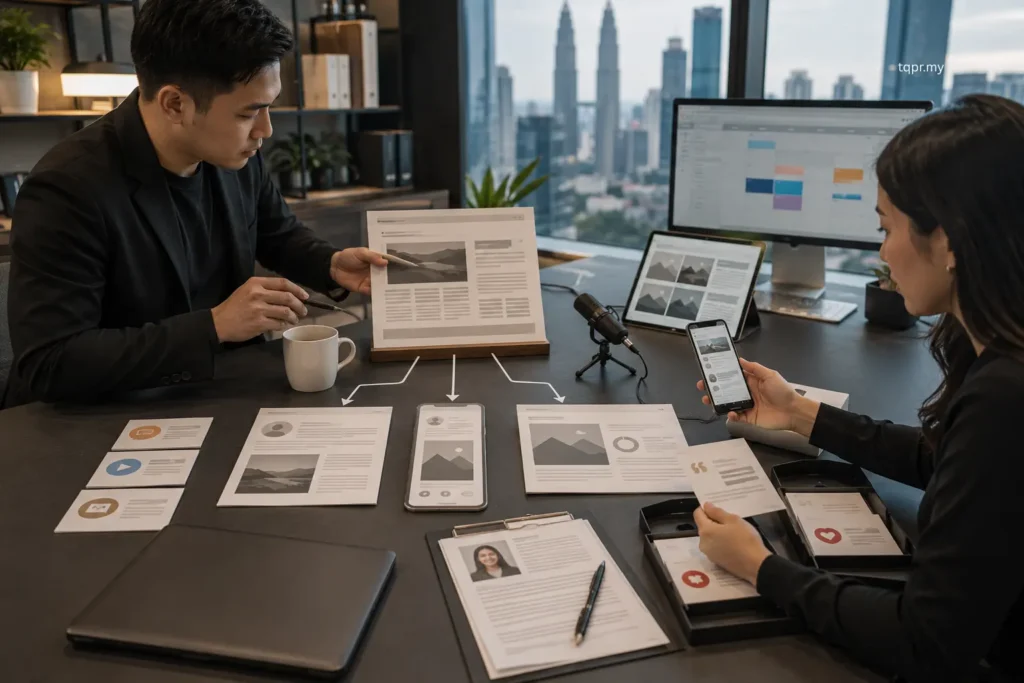
Social media should not begin only after a media article is published. Social media management for PR can support the entire media cycle.
Before outreach, a credible owned presence gives journalists and other stakeholders useful context about the business and its spokespeople. During a campaign, social content can reinforce the same themes being introduced through media relations and strategy. After coverage lands, the brand can amplify it, add perspective and keep the topic active.
Good amplification does not mean posting a link with “We are pleased to be featured.” The social post should explain why the story matters, pull out a useful point and give the audience a reason to engage with the coverage.
Earned media can also be repurposed carefully. A spokesperson quote may become an executive post. A media interview may generate several short educational pieces. A recurring journalist question may reveal a topic worth addressing more clearly on social media.
This extends the useful life of media activity without pretending that owned content and independent coverage carry the same kind of credibility.
3. Launches and announcements become disconnected
Launches often involve multiple teams, deadlines and approval routes. PR may be preparing the media angle, press materials and spokesperson briefings while marketing is handling campaigns and social content. Without one communications calendar, information may be published too early, important claims may differ or the social feed may fail to support the announcement at all.
Social media management for PR keeps owned-channel execution aligned with the main launch plan. That includes deciding:
- what can be teased before the announcement;
- which facts and assets are approved;
- when each platform should publish;
- how media coverage will be amplified;
- who will handle public questions; and
- what content keeps the story moving after launch day.
The social plan should reflect the role of each platform. LinkedIn may carry corporate context and leadership commentary. Instagram or Facebook may communicate more directly with customers. Short-form video may demonstrate the product or make a technical subject easier to understand. The message remains aligned even when the presentation changes.
4. Routine responses become improvised or inconsistent
Many reputation problems begin as ordinary online interactions. A customer asks a difficult question, an employee-related concern appears in a comment, or a complaint attracts unexpected attention. The first public response may shape whether the matter is resolved quietly or escalates.
Social media management for PR gives community managers clear boundaries. Routine enquiries can be answered through approved guidance. Sensitive cases can be documented and escalated instead of being handled through improvised replies.
A practical response system should define:
- issues the social team can answer independently;
- claims that require operational verification;
- subjects that need communications, legal or management review;
- expected approval times;
- who can pause scheduled content; and
- when the organisation activates a wider response process.
This does not mean every negative comment is a crisis. Over-escalation slows the team and makes the brand defensive. The objective is to distinguish manageable criticism from a developing reputation risk.
5. Reputation signals are detected too late
Social platforms are both publishing channels and early-warning systems. Social media management for PR should therefore include more than reading comments under the brand’s own posts.
Teams may need to watch brand mentions, recurring complaints, executive references, campaign reactions, competitor narratives and relevant industry conversations. These signals become more useful when combined with wider media monitoring and reporting.
The social team should escalate when there is:
- credible evidence of harm or misconduct;
- rapid or sustained spread across communities;
- attention from journalists, regulators or influential third parties;
- employee, partner or customer impact;
- significant misinformation that cannot be corrected easily; or
- an operational consequence such as cancellations, support spikes or disrupted service.
At that stage, replying one comment at a time is no longer enough. The communications lead needs verified facts, a coordinated message and clear decision rights. TQPR’s social media backlash response framework explains how that escalation should work.
6. Visibility disappears between major PR moments
Not every month contains a major announcement, and forcing weak news into the media can damage credibility. Social media management for PR gives the organisation a useful way to remain visible between genuine earned-media opportunities.
That visibility can come from:
- executive observations on relevant industry developments;
- explanations of complex customer or stakeholder questions;
- evidence from completed work;
- employee or operational stories with a clear purpose;
- commentary on research and market changes; and
- follow-up content that develops themes introduced through earlier PR activity.
The aim is not to manufacture noise. It is to build a recognisable body of communication that supports the organisation’s position over time. When a journalist, prospective partner or potential employee researches the company, the social presence should help them understand what it stands for and what it knows.
Social Media Management for PR vs General Social Media Marketing
The disciplines overlap, but their primary objectives are different.
| Area | Social media management for PR | General social media marketing |
| Primary purpose | Support reputation, messaging and stakeholder communication | Drive audience growth, demand, leads or sales |
| Strategic starting point | Communications objective and stakeholder priorities | Marketing objective and customer funnel |
| Typical content | Corporate narratives, expertise, earned-media amplification, announcements and issue communication | Promotional campaigns, offers, product content and conversion activity |
| Community focus | Understanding, response discipline and reputation signals | Engagement, customer interaction and conversion support |
| Common measures | Message consistency, audience quality, stakeholder response and reputation insight | Reach, clicks, leads, conversions and return on advertising spend |
| Escalation | Connected to PR, management, operations and crisis governance | Often connected to customer support and campaign management |
This does not mean PR-led social content cannot support commercial growth. Clear explanations, credible expertise and strong third-party coverage can improve trust and consideration. However, the service should not be evaluated as though every post were a direct-response advertisement.
Similarly, a business seeking immediate leads at a defined acquisition cost may need paid social or performance marketing rather than a PR-led social programme. The brief should match the outcome.
What a Social Media Management for PR Scope Should Include
A useful scope should be specific enough to prevent gaps and flexible enough to respond to real communications activity.
Communications and channel review
The agency or internal team should understand the business objective, priority audiences, current narrative, active campaigns, reputational sensitivities and approval structure. It should also confirm which social platforms genuinely matter rather than spreading effort across every available channel.
Content pillars and calendar
Content pillars should connect to PR themes, business priorities and audience needs. The calendar should include planned corporate moments, media activity, executive content and enough flexibility for relevant developments.
Copy and asset coordination
Social media management for PR may involve original copy, adaptations of longer materials, media-coverage amplification and coordination with designers or video teams. The scope should state what production is included and who supplies source material.
Where longer materials are needed, PR copywriting support can help turn the same communications direction into press materials, speeches, articles, briefing documents and other formats.
Publishing and platform coordination
The team should know who schedules, publishes and checks each post. Access, passwords, platform permissions and backup ownership should be settled before a launch or sensitive announcement.
Community management and escalation
The scope should define response hours, expected turnaround, common reply categories, prohibited interactions and escalation contacts. Customer service case resolution, legal advice and round-the-clock monitoring should not be assumed unless included.
Reporting and recommendations
Reports should explain what performed, which messages resonated, what audiences questioned and what should change. A list of impressions and engagements without interpretation is not enough.
What Social Media Management for PR Does Not Automatically Include
The label should not be used to hide an unclear scope. Depending on the provider, the service may not automatically include:
- proactive journalist outreach;
- a complete public relations strategy;
- spokesperson training;
- major photography or video production;
- paid media buying and optimisation;
- influencer sourcing and contracting;
- customer service case resolution;
- legal or regulatory advice;
- bilingual or multilingual adaptation;
- after-hours monitoring; or
- full crisis communications management.
These services can work alongside social media management for PR, but responsibilities and fees should be stated clearly. This is especially important when one agency handles several communications functions. Integration is useful only when the client still knows who owns each decision.
How This Works in the Malaysian Context
Social media management for PR in Malaysia requires more than adding local references to a regional content calendar. The team may need to make practical decisions around audience, language, platform culture and stakeholder sensitivity.
Language and localisation
Not every post needs to appear in English, Bahasa Malaysia and Mandarin. The right approach depends on the audience and purpose. However, teams should decide early whether content requires translation, transcreation or a separate local angle. Literal translations can weaken tone or introduce unintended meanings.
Platform behaviour
LinkedIn may be important for corporate positioning, recruitment and business audiences. Facebook, Instagram, TikTok, YouTube or other platforms may be more relevant for customer communication, campaigns or public education. The business should invest where its stakeholders actually pay attention.
Approval speed
Regional or multinational organisations often need input from local teams, regional management and headquarters. Social media management for PR becomes difficult when every routine post enters a long approval chain. A tiered system can keep low-risk content moving while giving sensitive claims and announcements the review they need.
Content responsibility
Digital promotional content may be subject to the Malaysian Communications and Multimedia Content Code and other applicable sector-specific requirements. Agencies and clients should establish responsibility for claims, disclosures, evidence and approvals, with qualified advice where necessary.
Cultural and reputational context
Tone, timing and public response can be affected by local events, religious periods, social sensitivities and language nuances. A locally informed team is better placed to identify when regional content should be adapted, delayed or avoided.
When a Business Needs Social Media Management for PR
This service is likely useful when:
- PR campaigns and social content are being planned separately.
- Media coverage is secured but poorly amplified or quickly forgotten.
- Brand and executive accounts communicate different versions of the story.
- The company needs consistent visibility between major announcements.
- Community managers lack response boundaries and escalation rules.
- Social feedback is collected but never informs communications decisions.
- A regional team needs more credible local execution in Malaysia.
- Senior management wants social activity to support reputation, not merely posting volume.
The service is less suitable when the only objective is immediate paid acquisition or high-volume promotional content. In those cases, performance marketing, an in-house content team or a specialist production partner may be the better lead.
How PR and Social Teams Should Work Together
Social media management for PR works best when the relationship is operational, not just conceptual. The teams should share one communications calendar, one approved message system and a clear escalation route.
A workable division of responsibility is:
| Responsibility | Typical lead |
| Communications strategy and stakeholder priorities | PR or communications lead |
| Message house and proof points | PR with management input |
| Platform plan and content calendar | Social lead with PR input |
| Social copy and asset adaptation | Social team |
| Media pitches and journalist handling | PR team |
| Routine comments and enquiries | Social or customer support |
| Sensitive public statements | Communications or crisis lead |
| Platform publishing during an issue | Social team under central approval |
| Combined reporting and recommendations | PR and social together |
During normal operations, a regular planning and reporting rhythm may be enough. During a launch or developing issue, one communications owner should coordinate timelines, facts and approvals across both teams.
If the matter creates credible stakeholder or operational risk, crisis communications support should take the lead. Social remains important for monitoring and publishing, but it should not be expected to manage the wider response alone.
How to Measure Social Media Management for PR
Social media management for PR should not be judged only by follower growth, likes or the number of posts published. Those figures can be useful, but they do not show whether the activity supported the communications objective.
A stronger scorecard may include:
- reach among the intended stakeholder or audience group;
- engagement quality rather than raw reaction volume;
- message consistency across social and earned media;
- clicks to relevant articles, reports or campaign pages;
- useful questions, concerns and sentiment themes;
- response speed and unresolved issues;
- amplification and continued discussion of media coverage;
- executive or company visibility around priority topics; and
- recommendations that improve the next communications cycle.
Measurement should begin with a baseline. A business cannot interpret a change in sentiment, response volume or reach without knowing what normal activity looks like. Reporting should also distinguish between channel performance and the wider outcome. A post may perform modestly while still reaching a small but commercially important stakeholder group.
The final question is not “Did social media look busy?” It is “Did the activity help the right audience understand, trust or respond to the organisation more effectively?”
Questions to Ask a Social Media Management for PR Partner
Before appointing an agency, ask:
- How will the content calendar connect to our PR and business priorities?
- Who develops the messages and who adapts them for each platform?
- How will you work with our media relations, marketing and internal teams?
- What content, creative production and publishing are included?
- How are comments, direct messages and sensitive issues handled?
- What triggers escalation to senior communications or crisis support?
- Can you support Malaysian language and cultural requirements where needed?
- How will media coverage be used without making every post repetitive?
- What will the monthly reporting help us decide?
- Who will work on the account, and how involved are senior advisers?
The answers should reveal an operating model, not just a posting package. A supplier promising a large quantity of content without asking about messages, stakeholders, approvals or risk is unlikely to deliver PR-led social media management.
Frequently Asked Questions About Social Media Management for PR
Is social media management part of public relations?
It can be. Social media is a communications channel, while public relations is the wider function responsible for organisational relationships, reputation and stakeholder understanding. Social media management for PR applies the PR strategy through owned social channels and feeds audience response back into the wider programme.
Is this the same as social media marketing?
Not exactly. Social media marketing often prioritises audience growth, leads, sales and paid campaigns. PR-led social media management focuses more on narrative, credibility, stakeholder communication, media amplification and response discipline. A business may need both.
Does this service include media relations?
Not automatically. Social media management for PR can support and amplify media activity, but proactive pitching and journalist relationships should be listed separately if they are included.
Who should respond to negative comments?
Routine criticism and service questions can normally be handled by social or customer support using approved guidance. Credible allegations, fast cross-platform spread, media enquiries or wider stakeholder impact should be escalated to the communications or crisis lead.
Can the same agency manage PR and social media?
Yes, provided it has both strategic and operational capability. The advantage is better coordination. However, the scope should still identify who owns strategy, media relations, content production, publishing, community management and escalation.
Does every PR campaign need social media support?
Not every campaign requires a large social programme. However, most organisations should decide deliberately how their owned social channels will support, explain or extend the campaign. Silence can be appropriate, but it should be a strategic choice rather than an overlooked task.
How often should PR-led social content be published?
There is no universal posting frequency. The right cadence depends on the platform, audience, available evidence and communications objective. Consistent, useful publishing is better than filling the calendar with weak content.
How quickly can this service show results?
Operational improvements such as a clearer calendar, faster approvals and more consistent responses can appear early. Reputation, audience trust and thought-leadership outcomes take longer because they depend on repeated credible communication rather than a single campaign.
Final Word: Make Social Media Part of the PR System
Social media management for PR works when owned-channel activity supports the organisation’s wider message, reputation and stakeholder priorities. It gives PR strategy a regular public expression while giving the communications team direct insight into audience questions and emerging concerns.
The goal is not to make every social post sound corporate or turn every comment into a crisis. It is to establish enough coordination that content, media activity, community responses and sensitive issues do not operate as separate systems.
TQPR helps businesses connect practical social execution with wider public relations objectives in Malaysia. Contact TQPR to discuss the platforms, communications priorities and level of support your business needs.