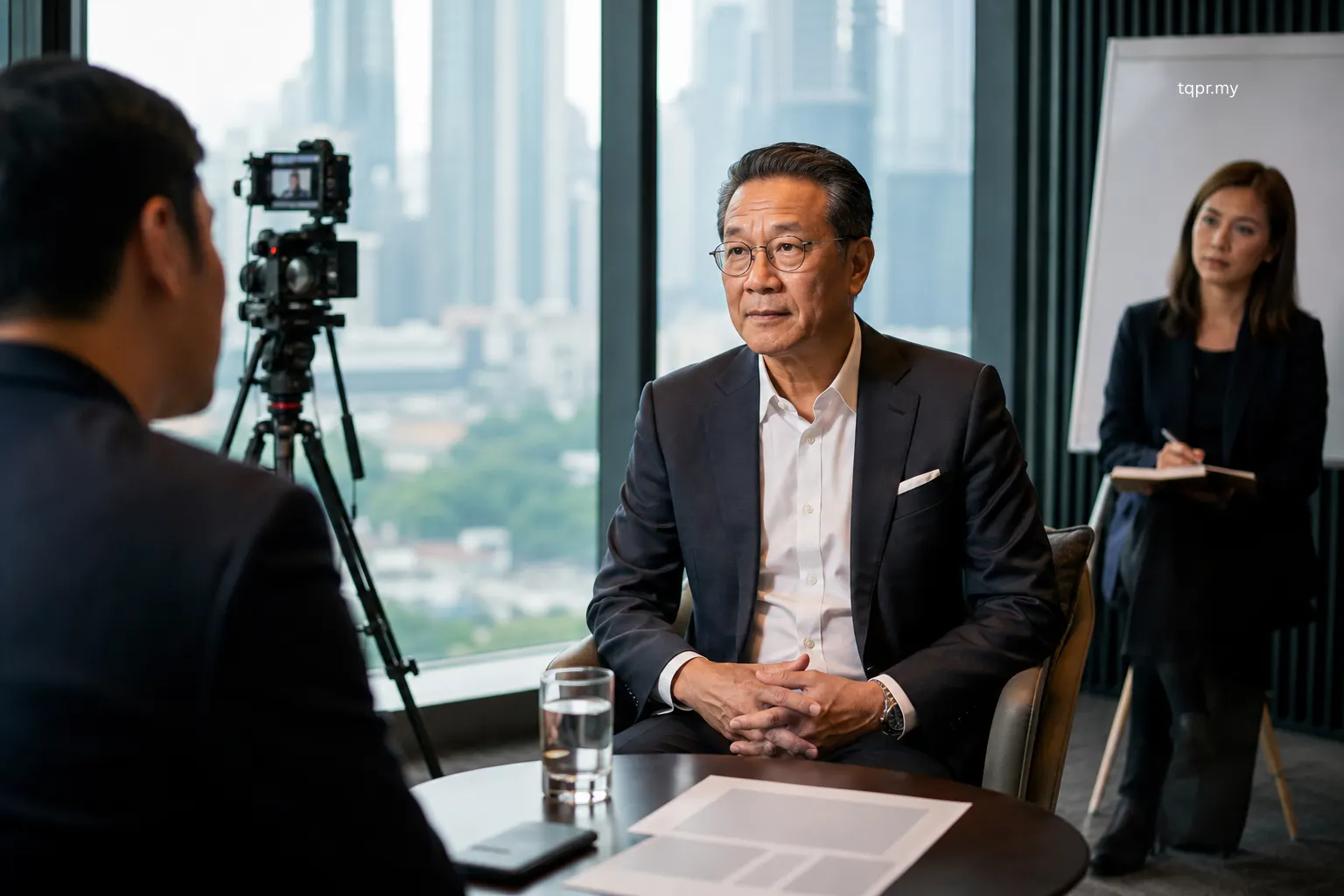

Choosing a PR agency is not simply a matter of comparing credentials decks, media lists and monthly deliverables.
You are appointing a team that may help shape how journalists, customers, partners, regulators and other stakeholders understand your organisation. The right PR agency should be able to translate a business objective into a credible communications strategy, then execute it within the realities of Malaysia’s media landscape.
The difficult part is that most agency proposals can look convincing at first glance. Similar services appear, familiar media logos are displayed, and ambitious outcomes are discussed. The real differences usually become clearer only when you ask how the PR agency thinks, who will actually handle the work and what it needs from your team to succeed.
If you are considering several agencies, these seven questions will help you evaluate more than presentation quality and choose a PR partner that fits your objectives, working style and market.
Key Takeaways: How to Choose a PR Agency in Malaysia
- Start with the business problem you need PR to address, not a list of desired deliverables.
- Look for relevant experience, but ask how the PR agency handled the work instead of relying only on client logos.
- Confirm who will actually manage your account after the pitch.
- Assess whether the PR agency can develop a credible story, not merely distribute press releases.
- Agree on meaningful success measures before the campaign starts.
- Examine how the PR agency handles approvals, sensitive issues and changing circumstances.
- Be realistic about what the PR agency will need from your internal team.
Before Comparing PR Agencies, Define What You Actually Need
Before asking agencies to present their ideas, define the reason you are looking for PR support.
Are you entering Malaysia, launching a product, building executive visibility, preparing for a sensitive issue or trying to establish credibility within a specific industry?
“Get more media coverage” is rarely a sufficient objective on its own. Coverage may be useful, but the PR agency needs to understand what that visibility should accomplish and which audiences matter most.
A clear PR agency brief helps each agency respond to the same business problem. It also makes comparisons fairer because you can assess their thinking against a consistent objective, audience, timeline and set of constraints.
Once that foundation is clear, ask the following seven questions.
1. How Would You Connect PR to Our Business Objective?
The first question should reveal whether the PR agency understands the difference between PR activity and PR strategy.
Ask:
“Based on our brief, what do you believe PR needs to change for our business, and how would you approach it?”
A thoughtful answer should connect communications activity to a clear outcome. That might include establishing credibility in a new market, improving understanding of a complex offering, preparing leadership for greater visibility or strengthening trust around a sensitive business issue.
Be cautious if the conversation immediately becomes a list of press releases, events, interviews and social posts without explaining why those activities suit the objective.
Deliverables matter, but they should follow the strategy. A PR agency should first clarify:
- Who needs to hear the story?
- What should they understand or believe?
- What proof can support the message?
- Why would the story matter now?
- Which communications channels and formats fit the objective?
- What could prevent the message from landing?
A strong PR partner may also challenge parts of your original brief. This is not necessarily a negative sign. If your desired tactic does not match the objective, the agency should be willing to explain why and recommend a more suitable approach.
2. What Relevant Experience Do You Have in Malaysia and Our Sector?
Experience matters, but relevance matters more than volume.
A PR agency may show an impressive list of previous clients without explaining what it actually delivered, which challenges it faced or whether the same team remains involved today.
Ask:
“Can you show us work that is relevant to our market, audience or communications challenge, and explain what your team actually did?”
Look beyond whether the PR agency has represented an identical company. Relevant experience may come from:
- Working with similar stakeholders or media verticals.
- Managing comparable regulatory or reputation sensitivities.
- Introducing an unfamiliar category to Malaysian audiences.
- Supporting a regional company entering Malaysia.
- Turning technical information into accessible media angles.
- Coordinating multilingual or multi-market communications.
- Managing launches with tight deadlines and complex approvals.
Ask the agency to walk you through the objective, its strategic reasoning, the execution challenges and what changed during the campaign. TQPR’s PR case studies in Malaysia demonstrate this distinction across launches, technology, capital markets, insurance, healthcare, consumer brands and other sectors.
Relevant sector experience can shorten the learning curve, but it should not replace strategic thinking. An agency that has worked with your competitors may know the category well, but you should also ask how it will avoid repeating the same positioning, story angles and media approach.
3. Who Will Actually Manage Our Account?

The people presenting the proposal are not always the people handling the day-to-day work.
Ask:
“Who will work on our account after appointment, and what will each person be responsible for?”
You should understand:
- Who owns the strategy?
- Who manages the daily account?
- Who writes and reviews media materials?
- Who handles journalist outreach?
- How involved will senior consultants remain?
- Who steps in if the account lead is unavailable?
- How many other accounts will the team be managing?
If senior expertise is important to you, confirm what “senior involvement” means in practice. It could refer to strategy reviews, message development, crisis escalation, media counsel or direct participation in key meetings. The term means little unless the responsibilities are clear.
You should also meet the people you will work with regularly. PR depends on fast communication, honest feedback and the ability to make decisions under deadline pressure. A polished pitch cannot compensate for an account team that lacks the capacity, judgement or authority to move the work forward.
The best team is not necessarily the largest. It is the team with the right combination of senior judgement, execution capability and responsiveness for your brief.
4. How Do You Develop a Story Before Pitching the Media?
Media relationships are valuable, but relationships alone do not make a weak announcement newsworthy.
Ask:
“How would you turn our business objective or announcement into a story that Malaysian media would consider relevant?”
The PR agency should be able to discuss audience relevance, timing, evidence, spokesperson value and editorial fit. It should also distinguish between what the company wants to announce and what a journalist’s audience would genuinely find useful.
Effective media relations in Malaysia usually involves:
- Identifying the strongest news or insight angle.
- Matching that angle to appropriate outlets and editors.
- Developing clear messages and supporting proof.
- Selecting the right spokesperson.
- Preparing useful media assets.
- Choosing between a release, briefing, interview, event or another format.
- Managing follow-up without treating journalists like a distribution list.
A useful test is to give each shortlisted agency the same sample announcement and ask how it would improve the story. You are not looking for free campaign work. You are assessing whether the agency can identify what is missing, distinguish a corporate message from a media angle and explain its reasoning clearly.
Be cautious of agencies that focus mainly on the size of their media database or promise that relationships can secure coverage regardless of the story. Credible earned media cannot be guaranteed simply because a press release has been sent.
5. How Will You Define and Measure Success?
PR measurement should be agreed before execution, not invented at the end of the month.
Ask:
“Which outcomes would you measure for this brief, and how would those findings improve the next phase?”
The answer should reflect your objective. Relevant measures may include:
- Quality and relevance of earned coverage.
- Visibility within priority media or stakeholder groups.
- Accuracy of key-message pull-through.
- Spokesperson or leadership visibility.
- Sentiment and narrative patterns.
- Relevant website visits or branded search activity.
- Enquiries or other actions assisted by PR.
- Share of voice within a clearly defined competitor set.
- Issues identified through monitoring.
- Recommendations for improving the next campaign cycle.
High clip counts may look impressive, but they do not automatically show whether the right story reached the right audience. A smaller number of relevant business, industry or national placements may be more valuable than a large collection of weak mentions.
TQPR’s guide to public relations KPIs in Malaysia explains why measurement should focus on business relevance, message quality and practical next steps rather than vanity metrics alone.
The agency should also explain what it cannot reasonably attribute to PR. Be cautious of overly precise commercial claims when the campaign has no suitable tracking, baseline or connection between communications activity and customer behaviour.
6. How Do You Handle Approvals, Sensitive Issues and Changes in Direction?
Even a straightforward campaign can encounter delayed approvals, leadership changes, factual disputes or unexpected scrutiny.
Ask:
“How would you manage approvals, sensitive information and a situation that changes after work has started?”
A good PR agency should establish:
- Who has authority to approve materials.
- Which claims require legal or compliance review.
- How urgent decisions will be escalated.
- What information must remain confidential.
- How message changes will be documented.
- Who can speak publicly and on which subjects.
- What happens if the original story becomes unsuitable.
- How the agency will respond if media interest turns critical.
This becomes particularly important for regulated businesses, public-facing leadership teams, regional organisations and companies handling reputation-sensitive subjects.
Professional judgement also includes knowing when not to make a claim, not to approach a journalist or not to respond immediately. PRCA Malaysia’s Code of Ethics & Integrity emphasises principles such as accuracy, accountability, transparency and responsible professional conduct.
Ask how the agency applies these principles when commercial pressure conflicts with communication risk. The answer will tell you more than a general statement about “protecting your reputation.”
7. What Will You Need From Our Internal Team?
PR is not a function that can always be outsourced and forgotten.
Ask:
“What will you need from us for the campaign to work, and how much internal time should we realistically allocate?”
Depending on the brief, an agency may need:
- Access to business context and subject-matter experts.
- Approved facts, research and proof points.
- Leadership or spokesperson availability.
- Product information and visual assets.
- Timely feedback and approval.
- Visibility on operational or reputation risks.
- Coordination with legal, marketing, regional or management teams.
- A named decision-maker who can resolve bottlenecks.
A credible agency should be honest about these dependencies. Promising strong outcomes without asking for access, evidence or timely approvals may indicate that the proposed plan is built around activity rather than substance.
This question also helps determine whether the working model is realistic. If your internal team has limited time, tell the agency upfront. It may recommend batching approvals, developing an evergreen message bank or focusing on fewer activities that can be executed properly.
A Simple PR Agency Evaluation Scorecard
Once the pitches are complete, score each agency against the same criteria instead of relying on presentation quality alone.
| Evaluation area | What to look for |
| Business understanding | Connects PR recommendations to the actual objective |
| Malaysian market fit | Understands local media, audience and stakeholder context |
| Relevant experience | Demonstrates applicable work and explains its contribution |
| Account team | Provides clear roles, senior access and realistic capacity |
| Strategic approach | Develops credible stories instead of relying on distribution |
| Measurement | Uses meaningful KPIs and turns reporting into next actions |
| Working compatibility | Sets realistic expectations for approvals, access and collaboration |
You can weight the categories according to the brief. Crisis preparedness may matter more for a regulated organisation, while media creativity and launch execution may carry greater weight for a new consumer product.
Warning Signs Before Appointing a PR Agency
A persuasive proposal should still be examined carefully. Common warning signs include:
- Guaranteed coverage in specific publications.
- A strategy built mainly around sending more press releases.
- Case studies with no explanation of the agency’s contribution.
- Senior leaders presenting the pitch but disappearing from the delivery plan.
- Large media lists treated as proof of relevance.
- Reporting based only on clip volume or advertising-value equivalency.
- No clear process for approvals, factual checks or sensitive issues.
- Unclear exclusions, additional fees or third-party costs.
- Little interest in your internal expertise, evidence or spokesperson access.
- Recommendations that could apply to almost any company.
No agency can control journalists, public reaction or every external event. What it should be able to demonstrate is disciplined preparation, sound judgement, relevant targeting, responsible execution and a clear process for adapting when circumstances change.
Frequently Asked Questions About Choosing a PR Agency in Malaysia
How many PR agencies should we shortlist?
For most organisations, three or four well-matched agencies are enough to create a meaningful comparison without making the process unnecessarily heavy. A larger formal procurement exercise may require more, but every agency should receive the same core brief.
Should we choose a specialist or full-service PR agency?
Choose based on the problem you need to solve. A specialist may offer deeper expertise in a particular sector or PR discipline, while a broader agency may coordinate several communications functions. The important question is whether the proposed team has the right capabilities for your objective.
Do awards matter when evaluating a PR agency?
Awards can support credibility, but they should not be the deciding factor. Examine the relevance of the work, the team’s actual contribution and whether the same people or capabilities will support your account.
Can a PR agency guarantee media coverage?
No credible PR agency should guarantee independent editorial coverage. An agency can commit to strategy, preparation, targeting, pitching, coordination and reporting, but publication decisions remain with editors and journalists.
Is a local Malaysian agency better than a regional agency?
It depends on the brief. A Malaysian agency may offer stronger local media context and market execution, while a regional network can help coordinate several countries. For multi-market campaigns, the strongest model often combines a consistent regional narrative with local execution in each market.
Should price be the main deciding factor?
Price matters, but proposals should be compared based on scope, team seniority, strategic involvement, deliverables and expected internal support. The lowest fee may not offer the strongest value if the scope is too narrow or the team lacks the required expertise.
Looking for the Right PR Partner in Malaysia?
Learning how to choose a PR agency in Malaysia comes down to asking how the agency thinks, who will handle the work and whether its proposed approach fits your actual business objective.
Do not select an agency solely because it presented the biggest media list, the most deliverables or the most polished pitch. Look for strategic clarity, relevant experience, a capable account team, responsible expectations and a working model your organisation can realistically support.
If you are planning a launch, building earned visibility, entering Malaysia or addressing a communications challenge, contact TQPR with your objective. The team can outline a practical PR approach based on your audience, timeline and market context.