
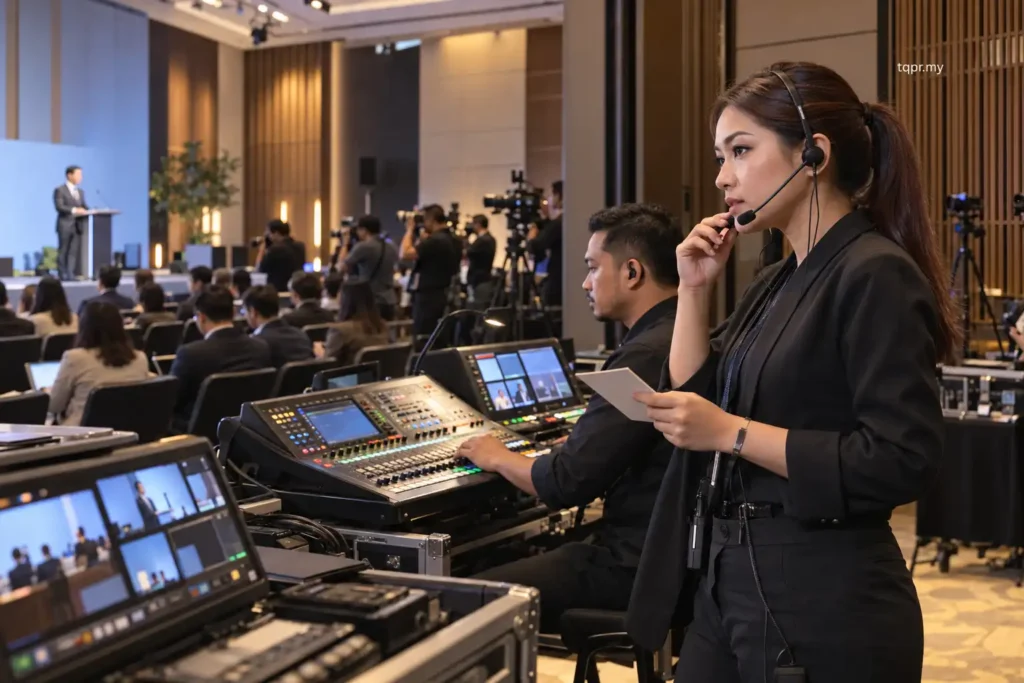
A media event run sheet is the internal, minute-by-minute plan that tells the people running a launch or press event what must happen, when it must happen, who is responsible and what to do if the plan changes. Unlike a guest agenda, it covers the operational details behind the announcement: media registration, spokesperson movements, technical cues, photography, interviews, approvals and contingency decisions.
For a Malaysian product launch, corporate announcement or media demonstration, the best run sheet serves two purposes. It keeps the event running safely and predictably, while making the news and the people behind it accessible to journalists. The template below shows how to build one without turning a straightforward briefing into an unnecessarily complicated production.
Media Event Run Sheet vs Event Agenda: What Is the Difference?
A guest agenda tells attendees what they can expect. A run sheet tells the working team how to deliver it. A production cue sheet goes one level deeper into the instructions for sound, video, lighting and stage movement. These documents should agree, but they are not interchangeable.
| Document | Main reader | What it contains | What it should not expose |
| Guest or media agenda | Journalists, speakers, invited guests | Arrival, programme, Q&A, interviews and departure | Internal phone numbers, security instructions, unresolved issues |
| Media event run sheet | PR lead, event producer, client lead, media desk and key suppliers | Timings, owners, media moments, speaker locations, approvals, escalation and fallback actions | Material beyond the authorised working team |
| Technical cue sheet | Show caller, AV operator, stage manager and technicians | Slide numbers, microphone states, playback files, lighting and precise trigger cues | Unnecessary strategic or confidential client information |
For a small media roundtable, one well-structured run sheet may be enough. A larger launch with demonstrations, simultaneous interviews or broadcast crews may need linked sheets for technical cues, interview bookings, media attendance and contacts.
The goal is not to produce more documents. It is to ensure that every person knows which version governs the live event.
Before Writing the Run Sheet, Decide Whether an Event Is the Right Format
A run sheet can make a good event easier to execute. It cannot make a weak announcement newsworthy.
Before committing to a venue and production schedule, ask what the journalists will gain by attending rather than receiving an email. It might be a demonstration, access to an executive, a facility tour, an opportunity to question technical specialists or visuals that explain a complex announcement.
If the story needs only a clear statement and a few quotes, targeted outreach or virtual interviews may be more efficient. TQPR’s guide on whether an announcement needs a press conference sets out the editorial and operational tests to make before choosing the format.
When the physical event is justified, document five decisions before you start scheduling individual segments:
- The news: What is the verified central announcement, and when can it become public?
- The audience: Which media, stakeholders and other guests have a genuine reason to attend?
- The useful experience: What can attendees see, ask, photograph or test that they cannot obtain remotely?
- The decision owner: Who can approve a programme change, answer a sensitive question or stop an unsafe demonstration?
- The success measure: What would meaningful progress look like beyond filling the room?
Those answers should shape the programme. A press demonstration needs time for hands-on access. A partnership announcement may depend more on a well-prepared joint statement and interview availability. A technical briefing may need a deeper Q&A rather than another ceremonial photograph.
Build the Run Sheet Around the News, Not the Stage Programme
Many event agendas are written around what the organising team wants to present. A media event run sheet should also consider what journalists need to produce accurate, useful coverage.
Protect the central announcement
Identify the exact segment when the key news becomes public. If a release, website update, regional announcement or social post is scheduled for the same day, record who controls it and the authorised release time.
Do not assume that an embargo applies simply because materials are marked “embargoed”. Where advance media access is being offered, terms should be clear and agreed before information is shared. A launch run sheet can record an agreed lift time, but it should not substitute for the outreach arrangement itself.
For multi-market announcements, write the date, time and timezone explicitly, for example “10:00 MYT (UTC+08:00)”. If a global or regional headquarters is controlling publication, confirm whether the Malaysian on-stage announcement may precede, coincide with or follow that release.
Give journalists time to do their job
Protect practical access rather than filling every minute with speeches. Depending on the story, this could include:
- a clear check-in point and a working media contact;
- a short, news-led opening;
- a demonstration that produces usable footage or photographs;
- genuine Q&A time, including difficult questions;
- pre-arranged one-to-one interviews;
- a quiet space for interviews or recording; and
- press materials that remain accessible after the event.
Avoid scheduling the most useful interview period at the same time as the main photo opportunity. If the same spokesperson is expected to appear in both, the conflict should be resolved on paper, not during the live programme.
Good media relations in Malaysia depends on relevance, clear information and journalist access. The run sheet is one way to make those decisions operational. Do not treat invitations, hospitality or gifts as a way to secure favourable reporting: journalists retain editorial independence, and attendance never guarantees coverage. The Society of Professional Journalists Code of Ethics provides a useful professional reference on independence, although it is not Malaysian law.
The Essential Fields Every Media Event Run Sheet Needs
The following fields give the working team enough information to act without searching through email chains and WhatsApp messages.
| Field | Example or instruction | Why it matters |
| Event, date and venue | Project name, full location and working room | Prevents confusion across similar projects |
| Document owner and version | “PR lead, v1.4, updated 17:00 MYT” | Identifies the current authorised plan |
| Start and end time | Actual clock times, not only durations | Supports crew and speaker coordination |
| Segment or action | “Product demo” rather than “activity” | Makes the required action clear |
| Location | Main stage, registration, demo bay or interview room | Prevents people being in the wrong area |
| Responsible owner | Named role or individual | Establishes accountability |
| Cue or dependency | “Wait for approved slide 7” | Shows what must happen first |
| Media requirement | Photo access, recording, translation or interview move | Protects journalistic usability |
| Fallback and decision owner | “Use still images if live demo fails; PR lead confirms” | Allows controlled changes |
| Status | Draft, checked, approved or completed | Helps track readiness and changes |
Use stable segment IDs such as M01, M02 and M03 if several teams are working from the same schedule. When a timing changes, everyone can still refer to “M07 interview transfer” instead of arguing about which row has moved.
Keep a compact contact and escalation sheet alongside the run sheet. It should include the authorised spokesperson liaison, PR lead, client decision-maker, AV lead, venue operations contact and safety lead where appropriate. Restrict that sheet to people who actually need the contact details.
Copyable Media Event Run Sheet Template for a Malaysian Launch
The sample below is entirely hypothetical. It depicts a compact weekday media demonstration at a venue in Kuala Lumpur. The company, programme and timings are examples, not TQPR client work or recommended industry benchmarks. Adapt the schedule to the venue, audience, travel requirements, announcement and approval process.
Sample event: A fictional company introduces new industrial monitoring equipment to Malaysian business and technology journalists.
Public news time: 10:00 MYT, subject to final internal and external release coordination.
| Time (MYT) | Segment / action | Owner | Cue or dependency | Media requirement / fallback |
| 08:00 | Venue handover and crew call | Event producer | Access and safety check complete | Resolve access problems before guests arrive |
| 08:20 | Test microphones, display, videos and demo equipment | AV lead + technical lead | Correct, approved files loaded | Hold backup microphone and demo recording |
| 08:45 | Spokesperson, moderator and demo rehearsal | PR lead | Final Q&A and claims cleared | Confirm who handles technical questions |
| 09:10 | Open media registration and asset-access test | Media desk | Attendee list and QR/asset links checked | Printed directions and offline fact sheet available |
| 09:30 | Journalist arrivals and informal orientation | Media liaison | Welcome team at entrance | Guide cameras to permitted positions |
| 09:55 | Five-minute standby | Show caller | All speakers and recording teams ready | Notify PR lead of delays or missing speakers |
| 10:00 | Moderator welcomes media and states news purpose | Moderator | Show caller gives opening cue | Keep introduction brief and clear |
| 10:02 | Lead spokesperson presents central announcement | Spokesperson | Release/publication timing confirmed | Use approved key facts; no unapproved figures |
| 10:10 | Equipment demonstration | Technical lead | Safety clearance and AV cue | Switch to verified recording or stills if live demo fails |
| 10:18 | Planned photo and video opportunity | Photo lead | Demonstration area clear and safe | Alternative approved group/photo setup |
| 10:23 | Moderated media Q&A | PR moderator | Appropriate spokespeople in position | Log unresolved questions for follow-up |
| 10:35 | Formal close and media directions | Moderator | PR lead confirms next segments | Point to interview room and media contact |
| 10:40 | One-to-one interviews and hands-on access | Media liaison + spokespeople | Booking grid confirmed | Reassign slots if a journalist is delayed |
| 11:10 | Remaining media requests and asset delivery | PR desk | Recording, captions and facts checked | Send verified materials to remote or absent media |
| 11:30 | Internal operational debrief | PR lead + producer | Press activity complete | Assign corrections and follow-up owners |
The opening-to-close segment in this example lasts 35 minutes. That is a planning illustration, not an instruction to make every launch the same length. A technical site tour could be much longer. A sensitive corporate statement could be shorter, while still needing more preparation.
For live production, create a companion cue sheet with precise slide numbers, video file names, microphone assignments, stage marks and a show caller. Avoid embedding sensitive media contact details or internal crisis notes in copies distributed to all vendors.
Blank template to copy into your planning document
| Segment ID | Start | Duration | Action | Location | Owner | Cue / dependency | Media requirement | Fallback / escalation | Status |
| M01 | [Time] | [Minutes] | [What happens] | [Place] | [Role] | [Trigger] | [What media need] | [Plan B and approver] | [Draft / approved] |
| M02 | [Time] | [Minutes] | [What happens] | [Place] | [Role] | [Trigger] | [What media need] | [Plan B and approver] | [Draft / approved] |
| M03 | [Time] | [Minutes] | [What happens] | [Place] | [Role] | [Trigger] | [What media need] | [Plan B and approver] | [Draft / approved] |
The template becomes useful only when real names, dependencies and fallback decisions are filled in. A row marked “PR team” as the owner is often too vague if several people are covering registration, the stage and interviews simultaneously.
Assign Owners for Media, Stage, Speakers and Decisions
A good media event run sheet separates the roles that can easily become confused when the event begins.
The client decision-maker approves matters such as a factual change, sensitive disclosure, significant programme alteration or cancellation. That authority should be agreed in advance.
The PR lead protects the news angle, media access, announcement timing, spokesperson readiness and journalist follow-up. This person should have a direct escalation route to the client decision-maker.
The event producer or show caller controls the operational sequence and issues live cues. The show caller should not have to wait for several conflicting instructions from different stakeholders.
The media liaison manages arrivals, journalist movements, interview slots and questions that need follow-up. A second person may be needed if there are multiple interview rooms or a large media group.
The spokesperson liaison keeps speakers ready, knows where they must be next and protects the interview schedule from unscheduled interruptions.
The technical and venue leads handle AV, equipment, access and venue-specific safety requirements. Their authority over immediate technical or safety action should be clear, even when a client would prefer the programme to continue.
A practical responsibility test is to ask: “If the main speaker is missing five minutes before going live, who makes the call?” If three people give different answers, the run sheet is not ready.
Use one controlled communication channel
A WhatsApp group can be useful for operational alerts in Malaysia, but it should not be the only source of truth. The approved run sheet must remain accessible offline or in a shared location, with version control. Critical instructions should use a clear escalation route, not disappear between vendor updates, guest messages and photography requests.
Use a short vocabulary for real-time changes: “hold”, “resume”, “move to backup demo”, “release speaker” and “await client approval”. Agree on who can issue each instruction. The language should be unambiguous to the people executing it.
Plan the Press Moments as Separate Operational Dependencies
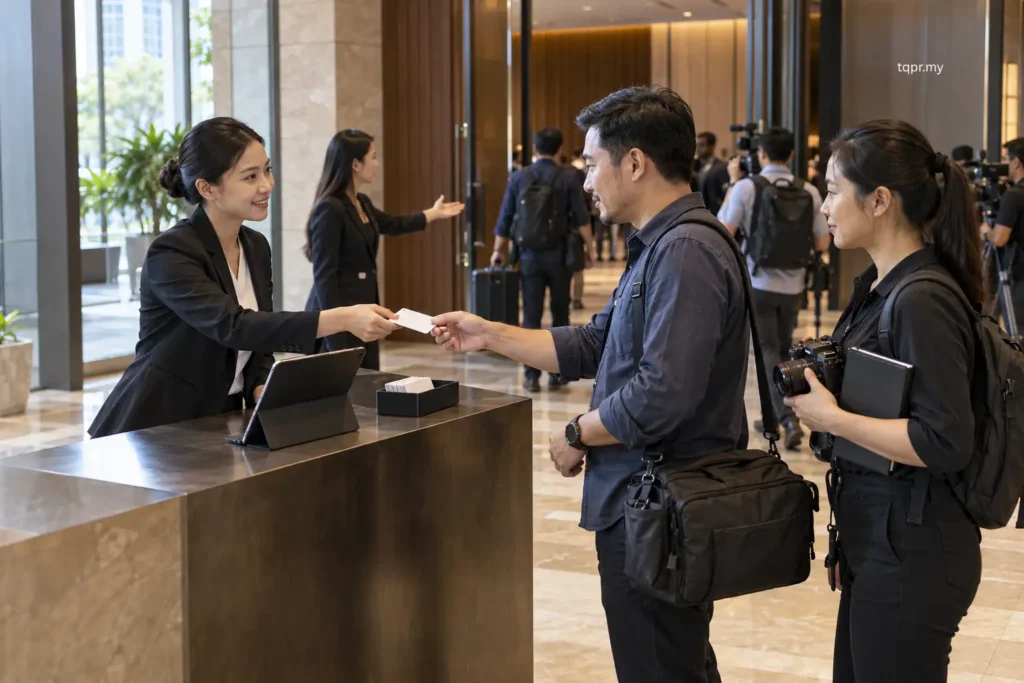
The schedule should not merely say “media handling”. Break it into activities with clear owners and realistic transitions.
Media registration and arrival
Confirm the media desk, attendee list, entry instructions, credentials where needed, Wi-Fi details and who will escort late arrivals. Make room for cameras or larger equipment, including any venue access requirements. Avoid creating queues that prevent journalists from reaching the opening on time.
Registration data should be collected and used for a defined purpose. The Malaysian Personal Data Protection Commissioner explains the principles of notice, choice, security, retention and access under the Personal Data Protection Act 2010. The exact legal obligations depend on the activity and the organisation; review your registration process rather than copying a generic form. Personal data collected for event operations should not simply become a marketing database without an appropriate basis and notice.
Photography and demonstrations
Record the photographer’s position, key moment, authorised participants, visual assets and required captions. Where a demonstration involves equipment, product claims or restricted access, agree on what may be photographed and how safety will be managed.
Do not let photography obstruct the demonstration or turn a staged visual into a misleading representation of what actually happened. If a photo cannot be taken safely or truthfully, use an accurate alternative.
Q&A and interviews
Identify who will moderate, which speakers can answer which subjects and how the team will handle questions needing verification. Include a visible end time for the formal Q&A but do not promise that journalists will ask only pre-approved questions.
A question that exposes an inaccurate figure should trigger a verification process, not improvised reassurance. Assign a note-taker to record requests, the spokesperson’s response and the owner responsible for any subsequent clarification.
Where the story may attract difficult questions, spokesperson media training can support preparation for the moment. The run sheet then ensures the right prepared person is actually available when the journalist needs an answer.
Press materials and remote access
Have the relevant press kit assets checked before opening registration. This might include the release, factsheet, images, captions, spokesperson bios, supporting data and a named media contact.
Record when each asset can be shared. An approved public fact sheet and confidential pre-launch briefing deck are not necessarily the same document. If regional journalists cannot attend, plan equivalent access to verified materials and interview opportunities where feasible.
Write Fallback Decisions Before the First Guest Arrives
A useful contingency plan is specific enough for someone to execute under time pressure. “Handle issues as they arise” is not one.
| What changes? | Pre-agreed operational response | Who decides? |
| Lead spokesperson is delayed | Start with an authorised alternative, or delay the public segment within a defined limit | PR lead and client decision-maker |
| Live demonstration fails | Use approved recorded footage or explain the limitation without staging a false demonstration | Technical lead for safety; PR lead for communications |
| Media turnout is low | Proceed with a proportionate briefing or shift emphasis to interviews; do not manufacture attendance | PR lead with client approval |
| Sensitive question raises an unverified fact | Acknowledge the question, avoid speculation and assign a verified follow-up | Relevant spokesperson and approved escalation owner |
| Broadcast crew needs extra setup time | Use a designated setup window or alternative filming position | Media liaison and venue/technical lead |
| Venue or equipment presents a safety concern | Pause or stop the affected activity and follow venue emergency procedures | Designated safety/venue authority |
| Global announcement time changes | Hold affected release, stage and owned-channel cues until a new authorised time is confirmed | Client communications owner and PR lead |
| Journalist requests material not cleared for release | Log the request and seek approval rather than forwarding a draft | PR lead and content owner |
The decision to stop an unsafe activity should not depend on whether a senior stakeholder is watching. Venue emergency instructions and applicable safety requirements take priority over the running order.
Make sure the run sheet distinguishes between recoverable delays and conditions that require an actual stop. Losing two minutes in a speech may be recoverable. A failed safety check, unsupported public claim or missing authorisation to disclose information is different.
Localise the Media Event Run Sheet for Malaysia
Localisation is not simply changing the event address to Kuala Lumpur. The schedule should reflect the people, place and announcement involved.
Language and interpretation: Decide which languages journalists and speakers are likely to use. Prepare approved terminology and translated figures for relevant English, Bahasa Malaysia, Mandarin or other-language materials. If interpretation is necessary, allow time and audio arrangements for it. Do not assume every spokesperson can answer technical questions with equal precision in every language.
Travel and access: Consider traffic, parking, public transport, loading access and time needed for video crews. A venue may be attractive to guests but inconvenient for journalists moving between assignments. A factory or facility visit in Penang, Johor or elsewhere may require a substantially different schedule from a city-centre briefing.
Calendar and programme timing: Review public holidays, festive periods, major industry announcements and important religious or community schedules. Friday prayer times may affect travel and availability for some participants. There is no universal “best media-event time” that overrides the journalists’ actual schedules.
Protocol and stakeholder approvals: A ceremony involving a government representative, overseas executive, partner organisation or regulated claim may need additional sequence and sign-off checks. Verify titles, pronunciation, arrival protocol, photo order and who can approve any public statement. Do not assume a general event checklist establishes legal or ceremonial requirements for a specific event.
Regional access: If the story affects Sabah, Sarawak or other markets beyond the event location, decide whether remote briefing access, regional spokespeople or targeted follow-up would serve those journalists better than expecting everyone to travel.
These details should be decided before the final cue sheet is issued, not added as last-minute notes to the emcee.
Rehearse the Decisions, Not Just the Speeches
A technical rehearsal checks that the microphone, video and presentation function. A useful media-event rehearsal also tests the moments where human decisions matter.
Run through the stage entry and exit, the handover from announcement to demonstration, the move into Q&A and the transfer of spokespeople to interviews. Check that the photographer’s best moment does not block cameras, that the approved facts agree across materials, and that speakers know who can answer technical or sensitive questions.
Then test at least two realistic disruptions:
- The demonstration does not work when cued. Who stops it, what alternative is shown, and what does the moderator say?
- A journalist asks for a number nobody has verified. Who handles the question, records the request and approves the eventual answer?
Add an additional rehearsal for a hybrid stream, live translation, unusual venue or complex stakeholder protocol. The purpose is not to script every interaction. It is to make sure the team can respond accurately without losing control of the event.
Before the final rehearsal, issue a version freeze: record the approved run-sheet version, the last update time and who can make changes. Later changes should be communicated directly to affected owners, especially the show caller, media liaison and spokesperson lead.
Do Not Let the Run Sheet End at the Closing Remarks
A media-facing programme is finished only when outstanding requests have owners. The final rows should cover the follow-through that makes the event useful beyond the venue.
Immediately afterwards, reconcile media attendance with actual check-ins, log interviews and questions, deliver assets that were promised and correct any known factual issues. Avoid sending unapproved recordings, draft slides or private contact details simply because the event is over.
Within the agreed reporting window, review which journalists requested further information, which angles attracted interest, what coverage actually appeared and whether the intended claims were understood accurately. Keep earned reporting separate from syndicated releases, sponsored content and the brand’s own posts.
The AMEC Integrated Evaluation Framework distinguishes communication outputs, audience responses, outcomes and organisational impact. That is a useful reminder that a completed programme, a full room and an attendance report do not establish business results. TQPR’s guide on measuring event PR success explores those distinctions in more detail.
A concise post-event debrief should answer three questions: What happened differently from the plan? What did the media or stakeholders actually need? What should change in the next event’s run sheet?
When In-House Planning Is Enough, and When Event PR Support Helps
A small, low-risk media briefing may be manageable internally if the organisation has an experienced coordinator, an approved story, available spokespeople and realistic media access. A straightforward run sheet and a single accountable lead may be sufficient.
Additional event PR support in Malaysia becomes more valuable when the story, production and stakeholder requirements must be coordinated across several teams. That can include a public-facing product demonstration, a multi-market launch with headquarters approvals, multiple interview streams or an announcement likely to attract difficult scrutiny.
When evaluating external support, ask who will own the run sheet, media handling, spokesperson liaison, production handovers, approval escalation and post-event follow-up. Clarify whether venue logistics and technical production are included or provided by separate suppliers. The weakest arrangement is one where every party assumes somebody else is responsible for the crucial media-facing moments.
TQPR’s event PR service connects planning, run-of-show coordination, media invitations, briefing materials, spokesperson preparation and follow-through. The scope should still be matched to the actual event rather than treating every launch as a full-scale production.
Frequently Asked Questions About Media Event Run Sheet
How detailed should a media event run sheet be?
Detailed enough that each working owner can act without seeking basic clarification. Record timing, responsibility, location, cue, dependency and fallback for meaningful segments. Technical teams may need a separate, more precise cue sheet. Guests normally need only the public agenda.
Who should control changes to the run sheet on event day?
The show caller or event producer should control the live operational sequence, while the PR lead and authorised client decision-maker handle communication and approval-sensitive changes. Safety or emergency decisions must follow the responsible venue and safety authorities. Agree on the boundaries before doors open.
Should journalists receive the internal run sheet?
Usually not. Give them a useful media agenda showing the programme, expected interview availability, access arrangements and media contact. The working run sheet may contain private contact information, security procedures, contingency plans and internal instructions that are not appropriate to circulate.
What if the media event starts late?
Check the reason and whether the announcement time is fixed. Protect essential media access, verified facts and safety requirements. Shorten lower-value segments before cancelling Q&A or interviews. If a coordinated release time changes, confirm authorisation and notify the relevant teams rather than improvising an inconsistent public announcement.
Make the Run Sheet Work for the Story
A useful media event run sheet is not a document to satisfy the event producer. It is the practical link between the announcement, the people responsible for it and the media experience on the day.
Start by deciding why the event is worth attending. Build the sequence around the news, the demonstration or access journalists actually need, then assign owners, cues and fallback decisions. Keep one approved version, rehearse the difficult handovers and leave time for follow-up after the formal programme ends.
If your organisation is preparing a launch, briefing or activation with several moving parts, contact TQPR Malaysia to discuss how event PR planning and media coordination could support the announcement.
Sources & Further Reading
- AMEC: Integrated Evaluation Framework – a planning and evaluation framework that distinguishes activity and outputs from audience responses, outcomes and impact.
- Personal Data Protection Commissioner Malaysia: Principles of Personal Data Protection – official guidance on the main principles relevant to handling attendee and media contact information. Organisations should check the application of current law to their own circumstances.
- Society of Professional Journalists: Code of Ethics – a professional ethics reference on journalistic independence and conflicts of interest; not a Malaysian legal requirement.