

A social media approval workflow is an agreed process for checking, approving and publishing a brand’s social posts. It defines who writes and reviews the material, what evidence must be checked, who can authorise publication and what happens when a post becomes sensitive or needs to change. For Malaysian businesses, a useful workflow also considers language, local market accuracy and regional headquarters approvals when relevant.
The goal is not to put every Instagram caption through five managers. It is to let straightforward content move efficiently while giving claims, personal information, announcements and sensitive responses the scrutiny they deserve. This guide provides a practical operating model, a worked example and a copyable approval template.
Why Social Media Approvals Fail Even When Everyone Is Checking
Many teams already have people looking at posts before they go live. That does not necessarily mean they have an approval process.
A designer shares an image in one WhatsApp group. Marketing approves the caption by email. A regional manager suggests a different date. Somebody uploads an older file because it was still in the shared folder. Later, nobody can establish which version was actually approved.
The problem is not always carelessness. It is unclear decision rights and a missing link between approval and the exact content published.
A workable process must answer five questions:
- Which version, account, language and publication time are under review?
- Who verifies the underlying facts, imagery and claims?
- Who has authority to approve the post, and who is the backup?
- What changes require a fresh review?
- Who can pause the publishing queue if circumstances change?
This is a narrower, operational question than the role of social media within public relations. TQPR’s guide to how social media management supports PR in Malaysia explains that wider relationship. The workflow below concerns the controls needed to execute that activity reliably.
Start With a Risk-Based Approval Matrix
The most important design choice is deciding which posts need which level of review. Treating every post as equally risky slows the calendar; treating every post as routine exposes the business to avoidable mistakes.
A simple four-route model works as a starting point. These are suggested internal categories, not official Malaysian regulatory classifications.
| Route | Typical example | Recommended approval | If the deadline passes |
| Routine | Previously approved brand tip, office-hours reminder or evergreen content with no new claims | Content lead checks accuracy, brand fit and final asset | Reschedule or hold; do not assume silence means approval |
| Claim-sensitive | New promotion, performance figure, product comparison or customer testimonial | Content lead plus the relevant commercial, product or factual owner | Hold until required evidence and sign-off are in place |
| High-stakes | Leadership announcement, regulatory subject, workplace matter or contentious public position | Corporate communications lead plus relevant senior, legal or specialist reviewers | Escalate to the named decision-maker; do not publish by default |
| Issue response | Viral complaint, allegation, safety concern or live reputation incident | Remove from routine scheduling and activate the issues or crisis approval route | Pause affected scheduled content until the incident owner authorises release |
The category should depend on the content and circumstances, not the platform. A routine LinkedIn update and an Instagram promotion with a sensitive health claim should not receive identical treatment merely because both are social posts.
It is also sensible to upgrade a post’s route when context changes. An otherwise harmless festive greeting may be inappropriate if a serious incident involving the organisation is unfolding. The content itself may not have changed, but the decision to publish has.
A risk matrix works best when staff have concrete triggers rather than vague instructions such as “send important posts to management”. Define what counts as a new claim, a sensitive topic, a use of personal information or a material change to an approved announcement.
Give Every Step an Owner and Every Approval a Decision-Maker
Small businesses may have one marketer and an owner. Larger Malaysian operations may involve an agency, corporate communications, business-unit experts and a regional headquarters team. Either arrangement can work if authority is clear.
| Responsibility | Primary job | What the person must not assume |
| Content owner | Draft caption, select assets, prepare posting details and incorporate feedback | That preparing the post automatically authorises publishing |
| Factual owner | Verify dates, prices, claims, product details and supporting evidence | That a correct fact makes the whole communication appropriate |
| Communications reviewer | Check audience relevance, tone, message consistency and reputational context | That they can approve specialist legal or technical claims without the required review |
| Final approver | Approve the specific version, account, language and timing | That later substantive edits remain covered by the original sign-off |
| Publisher | Schedule or publish the approved version and perform live checks | That access to a social account equals authority to decide the message |
| Incident owner | Pause content, route sensitive replies and coordinate a wider response | That a social manager should independently resolve a developing crisis |
One person may perform several jobs, but record the role being exercised at each stage. For material claims or higher-risk content, a second person’s check is usually worthwhile. Assign a backup approver who has genuine delegated authority; otherwise the entire calendar can stop when the usual approver is travelling.
Separate editorial sign-off from technical account access. An external agency might be responsible for drafting and scheduling but should not automatically receive unrestricted control of every brand asset. Meta, for example, distinguishes Page access and task access, with materially different capabilities. Review current permissions and provide only the access needed for the agreed work (Meta’s Page access guidance).
For teams with regional oversight, agree upfront which categories require headquarters approval and which have been delegated to Malaysia. The local team should not have to request regional permission for routine wording that falls within pre-approved boundaries, while country teams should not quietly change centrally approved financial or corporate statements.
Build One Review Record for Every Post
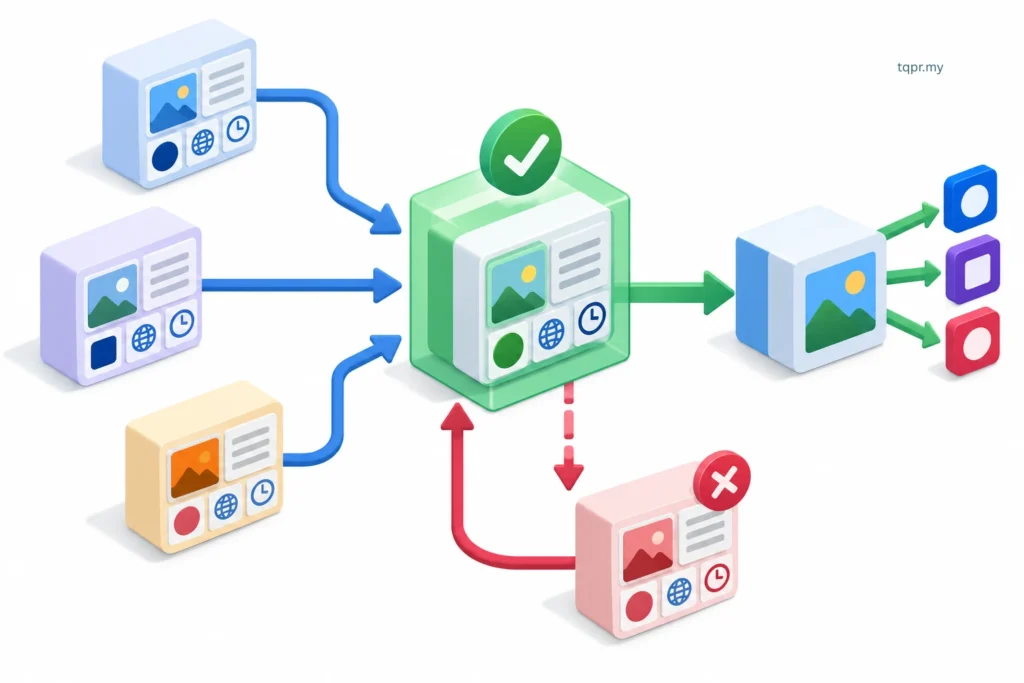
A shared monthly calendar is useful, but it is not necessarily a complete approval trail. Each post needs a record that makes the publishable version unmistakable.
At a minimum, capture:
- Post ID and owner: A unique identifier and the person responsible for moving it forward.
- Objective and audience: What the content is intended to achieve and who needs it.
- Platforms and accounts: The precise Facebook, Instagram, LinkedIn or other destinations.
- Language version: English, Bahasa Malaysia, Chinese or another language when relevant.
- Caption and creative: Final copy, image, carousel, video, subtitles and links in a single review package.
- Evidence and permissions: Source for material claims; image, testimonial, music and usage approvals as applicable.
- Risk route and reviewers: Required checks, actual decisions and unresolved issues.
- Publication details: Date, time zone, tags, links, call to action and any campaign restrictions.
- Version and status: Clear identifiers such as v03 – Approved and a record of subsequent changes.
- Live verification: Published URL, timestamp and any post-publication correction.
Avoid using the word “approved” to describe an entire content calendar if only topic ideas have been accepted. Topic approval, copy approval, creative approval and final publication approval are different decisions. A client may be happy with a product-launch concept but not yet have verified the announced date.
A standard approval record can sit in an established project-management platform, a suitable social publishing tool or a carefully managed spreadsheet with linked assets. What matters most is that the team can identify the current file and see the final decision without reconstructing several conversations.
Move the Post Through Clear Stages
A practical workflow has seven stages. Not every post needs a different person at each stage, but each stage needs an explicit outcome.
1. Brief and draft
Start with the purpose, audience and approved message. Create the caption and platform-specific creative together, not as unrelated tasks. The draft should state which facts remain unverified and identify any promised timing, discount, claim or quote.
Where a business has an approved message house, use it to check the central position and supporting proof. This helps maintain consistency without forcing identical phrasing across different channels.
2. Editorial and factual review
Check whether the material is understandable and accurate. Confirm names, figures, product availability, operating locations, offer terms, links and the context of any quotation. For imagery, confirm ownership or permission to use it. A good reviewer should be able to reject a vague or unsupported claim, not merely correct punctuation.
3. Specialist review where triggered
Route only the posts that need it to legal, compliance, HR, investor relations, technical experts or management. Give reviewers a specific question: “Can we substantiate this performance claim?” is better than “Please review all captions”. Reviewers should record whether they approve, request changes or decline approval.
4. Final sign-off on the exact version
The final approver sees the finished caption, visual, account, audience, language and scheduled timing together. If the creative is later changed to add a new price or the caption gains a new claim, that is a material edit and must be reapproved.
Minor formatting changes that cannot alter meaning may be pre-authorised in policy. Do not leave it to a junior publisher to decide whether a questionable change is harmless.
5. Schedule with the correct permissions
Only approved content enters the publishing queue. Check account selection, platform crop, link destination, scheduled time and time zone. Malaysia uses UTC+8; regional scheduling systems may display another time zone. Account access should be limited to staff or vendors who need it, and removed when responsibilities change.
6. Check what actually went live
A post that looked correct in a preview can still publish with a cropped graphic, broken link, missing subtitle or unintended tag. Open the live version, compare it with the approved record and correct or escalate issues promptly. Save the published URL rather than assuming that a scheduler’s “success” notification confirms every element rendered as intended.
7. Archive and learn
Keep the approved version, decision history and final link under the same post ID. If a correction was needed, document what caused it. Repeated errors often reveal a missing control or unclear responsibility, not simply an individual mistake.
For wider campaigns, define the handoff between social publishing and PR copywriting. A carefully approved press announcement may still require shorter, platform-specific wording, but that adaptation should preserve verified facts and the intended message.
Localise the Message Without Losing the Facts
A Malaysian brand may publish content in more than one language, and its audience may vary by state, sector, platform and campaign. That creates a common approval mistake: a team signs off on the English version and treats every adaptation as a straightforward translation.
Translations need a meaning check, not just a spelling check. Ask whether the final version preserves:
- The actual scope of a promotion, including eligibility and end dates.
- Product and service terms that cannot safely be simplified.
- The difference between a confirmed fact and a future intention.
- Names, positions and details that must remain consistent.
- Appropriate local tone without turning a cautious claim into a promise.
For example, “available at selected Klang Valley branches” must not become “available nationwide” in another language or a shorter Reel caption. If terms and conditions sit behind a link, verify that the link is usable and that essential conditions are not hidden or misstated.
Language review does not mean every brand must communicate in every language. Choose languages according to the actual audience and channel. Keep a common factual master, allow natural local phrasing and obtain an appropriate language review for material announcements.
Regional headquarters and Malaysian teams should also settle who can adapt references to public holidays, geography, local practices and audience expectations. A globally approved campaign concept can still contain wording or assumptions that do not fit the Malaysian market.
Add a Separate Rule for Comments, Complaints and Live Issues
Pre-publication approval covers scheduled content. Community management introduces a different decision: what can the team say in reply, and when must it stop and escalate?
Use an approved response matrix rather than asking every community manager to improvise.
| Incoming interaction | Routine handling | Escalation trigger |
| Opening hours, location or basic service query | Use an approved factual answer; direct to the correct information | Details are disputed or unavailable |
| Product availability or promotional terms | Confirm against the latest approved information | The customer cites a conflicting promise or material financial concern |
| Individual complaint | Acknowledge appropriately and move personal details to an authorised private channel | Credible safety, legal, discrimination, privacy or widespread service concern |
| Allegation circulating beyond the original comment | Do not argue or speculate in the comment thread | Notify the named communications or incident owner and review scheduled posts |
A routine community manager should not be expected to make crisis decisions on behalf of the organisation. A developing allegation may need facts from operations, legal review and senior decision-making before a public answer is authorised. For this situation, use the separate social media backlash and reputation crisis framework, rather than stretching an everyday content calendar into an incident-response plan.
The publishing policy should explicitly empower a designated person to pause affected scheduled content during a sensitive event. Pausing is not the same as deleting comments, admitting wrongdoing or issuing a statement. Those decisions need their own appropriate authority.
Malaysian Checks That Should Be Part of Final Approval
Not every social post is legally complex. Yet a useful Malaysian workflow identifies situations that warrant an additional compliance or specialist check.
Claims and advertising: When content makes a product, service, price or comparative claim, verify the evidence and qualifications before publishing. Malaysia’s Content Code 2022 discusses matters including false content, privacy and marketing communications. Its application depends on the content and the relevant circumstances; it should inform review without being treated as a universal checklist that automatically approves every advertisement.
Personal information and images: Confirm whether identifiable customer or employee material is suitable for the intended public use, whether the relevant permissions or other lawful basis are in place, and whether unnecessary details have been removed. Businesses handling personal data should consider applicable obligations under Malaysia’s Personal Data Protection Act 2010 and subsequent amendments, seeking appropriate advice when uncertainty is material. Not every identifiable image can be assessed from a generic rule alone.
Disclosure and integrity: Check whether a testimonial, paid collaboration or sponsored endorsement is presented in a way that could mislead readers about its nature. The PRSA Code of Ethics emphasises accurate communications and disclosure of relevant interests. This is an ethical reference, not a substitute for Malaysia-specific requirements that may apply to a particular campaign.
Accessibility: Review meaningful alternative text for informative images, accurate video captions where appropriate, readable overlays and information that is not communicated only through colour. The W3C’s social media accessibility guidance identifies alternatives and captions as useful features for accessible social content. Platform capabilities vary, so check the format before publishing.
This list is a screening tool, not a legal opinion. Sector-specific rules may impose additional requirements, particularly in regulated industries. Assign those questions to the appropriate qualified reviewers rather than expecting a social media executive to determine compliance alone.
Example: A Malaysian Launch With Regional HQ Approval
The scenario below is hypothetical and illustrates how a workflow might operate. It does not describe an actual TQPR client or a required industry standard.
A Malaysian B2B logistics company plans to announce expanded fulfilment capacity. The local team wants three pieces: a LinkedIn company announcement, an Instagram visual and an English-and-Bahasa Malaysia customer update. Its regional headquarters approves corporate claims, while the Malaysian operations lead controls the local facts.
| Stage | Owner | Evidence or decision |
| Four working days before launch: brief | Malaysia communications lead | Purpose, audience, confirmed launch scope, channels and timetable |
| Three days before: factual check | Malaysia operations lead | Confirmed facility details, availability dates and any limitations |
| Two days before: messaging review | Regional corporate communications | Approved phrasing for capacity, market presence and business plans |
| One day before: language and creative review | Local language reviewer and content lead | Consistent terms, correct graphic, functioning links and final versions |
| One day before: final approval | Named delegated approver | Sign-off for specific LinkedIn, Instagram and customer-update files |
| Launch day: publish and monitor | Authorised publisher | Live links, timing and first-response monitoring |
Now imagine operations discovers that a claimed service start date must move by a week. The previous approval is no longer valid for the affected posts. The team holds publication, revises the English master, updates the Bahasa Malaysia adaptation and sends the material fact back to its designated approvers.
The lesson is not that every caption needs six people. The lesson is that a changed fact must reach all affected versions before publication, with someone authorised to make that decision.
Copyable Social Media Approval Template
The following is an illustrative one-page record that a business can adapt to its existing tools.
| Field | Entry |
| Post ID / campaign | [Reference] |
| Content owner | [Name] |
| Objective and intended audience | [Specific purpose and audience] |
| Account(s) and format(s) | [Platform, account, post/story/video] |
| Publication time | [Date, time, MYT or relevant time zone] |
| Language version(s) | [English / BM / Chinese / other, as applicable] |
| Approved caption and asset link | [Stable link to exact final version] |
| Facts and permission checks | [Source, claim owner, rights or consent status] |
| Risk route | [Routine / Claim-sensitive / High-stakes / Issue response] |
| Review decisions | [Name, role, approve / revise / decline, date] |
| Final sign-off | [Named approver, version ID, timestamp] |
| Publishing status | [Draft / In review / Approved / Scheduled / Published / Held] |
| Live URL and checks | [Link, checked by, timestamp, any correction] |
Agree on a few non-negotiable operating rules alongside the template:
- No response is not approval. A missed review deadline means the owner escalates, reschedules or holds the post.
- One final version. An approval applies to the specific caption, asset, account, language and timing recorded.
- Material changes reopen review. New claims, dates, offers, visuals or sensitive wording must follow the required route again.
- One pause authority. A named owner or deputy can stop relevant scheduled content during an unfolding issue.
- One record of corrections. The live post is checked and material errors are logged with the action taken.
These controls are more important than choosing a particular software product. A tool may assist with routing and version history, but it cannot establish whether a price is correct or whether a public statement is appropriate.
Measure Whether the Workflow Is Working
Approval governance should not become an excuse for slow or repetitive administration. Review it after the first month, then refine the routes according to actual problems.
Useful indicators include:
| Measure | What it can reveal | Important limitation |
| Median time from review-ready to sign-off | Whether approvals are becoming a bottleneck | Very fast approval is not necessarily careful approval |
| Posts requiring multiple revision rounds | Unclear briefs, missing evidence or inconsistent review | Some important posts legitimately need more scrutiny |
| Percentage published with a complete final record | Whether the team follows its controls | A completed form does not prove the content is correct |
| Post-publication corrections | Repeating content or publishing errors | Low numbers may reflect weak detection or under-reporting |
| Number of missed slots due to delayed approval | Whether deadlines and backup approvers are workable | Delaying a risky claim may be the right outcome |
| Escalation handling time | Whether the right person is being reached when needed | Response speed must not replace fact verification |
Do not optimise every measure towards zero. A high-stakes announcement taking longer than an evergreen tip is evidence that the process recognises risk, not necessarily that it has failed.
For the first review cycle, ask staff where they have to guess: who owns a customer claim, when a new version needs sign-off, who can stop scheduled posts and where the final approved file lives. Simplifying those handoffs can matter more than adding another approval stage.
When Should a Business Bring In Social Media Management Support?
An in-house arrangement may be sufficient when a brand has a small content calendar, clear business facts and a reliable approver. There is little benefit in buying a complicated tool or outsourcing every caption merely to formalise a straightforward process.
External support becomes more reasonable when publishing covers multiple accounts, audiences, languages, campaigns or approval layers; when the team struggles to keep messages aligned with PR; or when community handling regularly raises questions beyond a routine social executive’s remit.
Before appointing an agency, clarify the split between planning, drafting, approvals, publishing, monitoring and response escalation. Ask who owns brand accounts and files, which changes require client sign-off, how publishing access is granted or revoked and what happens if a post must be paused urgently. A retainer should not leave critical decisions ambiguous.
TQPR’s social media management service in Malaysia includes content planning, platform coordination, publishing support, basic community response guidance and reporting that connects social execution with wider communications. The exact responsibilities and approvals should be agreed for the engagement rather than assumed.
Frequently Asked Questions
Can a Malaysian business use WhatsApp to approve social media posts?
Yes, a small team can use WhatsApp as a communication channel, but a vague “OK” beneath a screenshot is a poor permanent approval record. If WhatsApp is used, identify the exact final version and publication details, preserve the decision in the central content record and make sure the person replying actually has approval authority. For more complex operations, a structured review tool may reduce uncertainty.
What if a manager does not reply before the scheduled posting time?
Hold or reschedule the post unless an authorised backup has reviewed it under a documented delegation. Silence should not be treated as consent. If recurring delays are affecting routine posts, simplify the approval route or assign a backup, rather than allowing publishers to bypass the rule.
Should an agency be allowed to publish without client approval?
That depends on the agreed scope and risk level. A client may delegate final approval of routine, pre-authorised content to the agency, while retaining sign-off over new claims, financial announcements and sensitive issues. Put those limits in writing, alongside access permissions and an emergency pause procedure.
Make Approval Easier Without Weakening Accountability
A social media approval workflow is effective when the team knows what is ready, who has decided, and what is allowed to go live. Separate routine posts from risky ones, attach sign-off to the actual version, give local and regional reviewers defined responsibilities and make it easy to pause or correct a post when facts change.
For Malaysian businesses, that discipline supports consistent day-to-day social activity without disconnecting the brand from its wider communications responsibilities. If your organisation needs clearer planning, publishing responsibilities or community escalation rules, contact TQPR Malaysia to discuss an appropriate social media management approach.
Sources & Further Reading
- Hootsuite: How to Build a Social Media Approval Process (2026) – workflow patterns, ownership, review stages and version control.
- Meta: About Facebook Page Access – distinctions between full, partial and task-based Page permissions.
- Communications and Multimedia Content Forum of Malaysia: Content Code 2022 – Malaysian industry self-regulation guidance addressing content, advertising and other topics.
- Personal Data Protection Commissioner: Personal Data Protection Act 2010 and Amendment Act 2024 – official Malaysian legislative reference and amendment information.
- PRSA: Code of Ethics – professional standards on accuracy, disclosure and responsible communications.
- W3C WAI: Guidelines to Make Your Social Media Platform Accessible – accessibility considerations for images, audio and video in social tools.